










































Key Takeaways
- The India–AI Impact Summit 2026 will be the first global AI summit to be hosted in the Global South.
- It will be held from 16 to 20 February 2026 at Bharat Mandapam, New Delhi, as a five-day programme covering policy, research, industry, and public engagement.
- It will be anchored on 3 foundational pillars, or ‘Sutras’: People, Planet and Progress.
- The India AI Impact Expo is expected to feature over 400 exhibitors across more than seven thematic pavilions, with participation of over 1.5 lakh visitors.
Introduction

Artificial Intelligence (AI) is a key enabler of India’s development journey, strengthening governance and improving public service delivery. For India, AI supports inclusive growth at scale and aligns with the vision of Viksit Bharat by 2047. India’s linguistic and cultural diversity positions it strongly for advancing multi-lingual and multi-modal AI systems tailored to diverse public needs.
Building on India’s development-focused approach to AI, the India–AI Impact Summit 2026is scheduled to be held on 16–20 February 2026 at Bharat Mandapam, New Delhi. The summit will be the first global AI summit to be hosted in the Global South. It will bring together global leaders, policymakers, technology companies, innovators, and experts to showcase and deliberate on the transformative potential of AI across governance, innovation, and sustainable development.
Taking forward outcomes from major international AI forums, India’s approach through the India–AI Impact Summit 2026 will focus on translating global discussions into development outcomes aligned with national priorities under the IndiaAI mission and Digital India Initiative. It will strengthen multilateral cooperation while advancing practical, people-centric AI frameworks relevant to India’s governance, economy, and society.
Significance of AI for India
AI has emerged as a transformative force with the potential to accelerate India’s economic growth, strengthen governance and improve the quality of life of citizens, anchored in the principles of People, Planet, and Progress. For People, AI-enabled solutions are empowering citizens by expanding healthcare access through telemedicine and diagnostics, personalizing education through adaptive learning, and securing financial systems through fraud detection. For the Planet, AI is enabling smarter and more sustainable practices in agriculture through crop prediction, precision farming, and drone-based monitoring. For Progress, AI is strengthening governance through language translation of court judgments, improving service delivery, and enhancing everyday efficiency through applications in food delivery, mobility, and personalized digital services, reflecting a shift towards inclusive and accessible technology for both rural and urban India.
- AI In Healthcare: AI is improving healthcare access and outcomes, particularly in rural and underserved areas. AI-enabled remote diagnostics and portable tools support disease detection where doctors are scarce, while automated blood and urine testing accelerates diagnosis and treatment. AI-powered telemedicine, including chatbots and symptom checkers, connects rural patients to doctors, reducing travel and wait times. AI-based medical image analysis enables faster diagnosis of TB, cancer, and other conditions in remote areas. Predictive analytics support disease outbreak forecasting, while AI-driven drug discovery and personalized therapies improve affordability and outcomes for chronic conditions.
- AI in Agriculture & Rural Economy: AI is enabling smarter, data-driven farming practices to enhance productivity and farmer incomes. AI predicts weather, pest outbreaks, and irrigation needs, guiding farmers through mobile advisories. AI-powered drones monitor crop health and reduce waste, while satellite imagery and weather data support harvest forecasting. Market price prediction models help farmers anticipate demand and supply trends. Tools such as Mossum GPT and initiatives like Kisan E-Mitra provide real-time, localized agricultural information in regional languages.
- AI in Education & Learning: AI is making education more personalized, inclusive, and accessible. AI-driven platforms adapt learning content to individual student needs, supporting both slow learners and advanced students. AI-powered language translation removes linguistic barriers by converting content into regional languages. AI-based tutoring systems offer instant feedback and 24/7 learning support. Platforms such as DIKSHA use AI to deliver relevant and accessible educational content across diverse learner groups.
- AI in Finance & Commerce: AI is strengthening financial security, inclusion, and service efficiency. AI-powered systems detect fraud and secure digital transactions in real time. AI-based credit scoring expands access to loans for unbanked and underserved populations. Banking chatbots provide 24/7 assistance for routine services such as balance checks and fund transfers, reducing wait times. AI-driven personalization enables tailored financial products and advice.
- AI in Governance & Public Services: AI is enhancing the efficiency, accessibility, and transparency of public services. AI-assisted translation of court judgments into vernacular languages improves access to justice. AI supports smart city management by optimizing traffic, waste, and public safety systems. AI streamlines government service delivery by reducing processing times for schemes and applications. In the judiciary, AI improves case management and legal accessibility.
Recognising the strategic importance of AI, the Government of India has accorded high priority to building a robust and inclusive AI ecosystem. Initiatives such as the IndiaAI Mission, development of AI compute infrastructure, promotion of indigenous AI models, and large-scale capacity-building programmes are laying a strong foundation for responsible and trusted AI adoption in the country.
Further, the India–AI Impact Summit 2026 will focus on strengthening global collaboration, promoting responsible and ethical AI, and accelerating AI adoption across priority sectors of the economy. The Summit is expected to play a catalytic role in positioning India as a global hub for AI innovation and deployment, aligned with the vision of a digitally empowered and technology-driven India.
Foundational Pillars: The Three Sutras and Seven Chakras Driving Global Collaboration of AI Impact
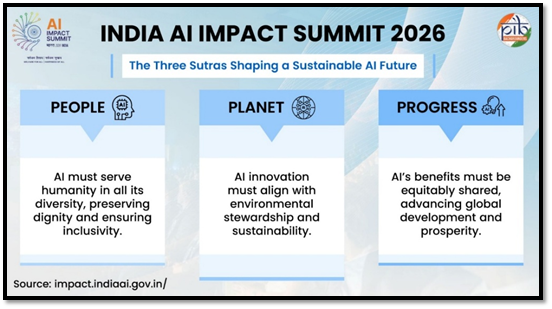

The India–AI Impact Summit 2026 aims to advance an impact-oriented and people-centric approach to Artificial Intelligence, with emphasis on delivering measurable social and economic outcomes. The Summit will be anchored on three foundational pillars, known as ‘Sutras’—a Sanskrit term meaning guiding principles or essential threads that weave together wisdom and action. These Sutras define how AI can be harnessed through multilateral cooperation for collective benefit.
Building on the three foundational Sutras, the deliberations at the AI Impact Summit will be structured around 7 Chakras. These Chakras represent key areas of multilateral cooperation that channel collective efforts towards inclusive and sustainable societal outcomes.
- Human Capital:This chakra focuses on building an equitable AI reskilling ecosystem through targeted skilling. For India, this strengthens workforce readiness for the AI economy, aligned with national development priorities.
- Inclusion for Social Empowerment: This chakra focuses on enabling inclusive participation through shared AI solutions and scalable models. This supports delivery of citizen-centric AI solutions and strengthens last-mile services in India.
- Safe and Trusted AI: This chakra focuses on translating global principles for responsible AI into practical, interoperable safety and governance frameworks. For India, this strengthens domestic AI governance, supports safe deployment of AI across public platforms and builds public trust while enabling innovation.
- Resilience, Innovation and Efficiency: This chakra focuses on addressing the growing environmental and resource challenges posed by large scale AI systems, which risk deepening the global AI divide. For India, it supports sustainable AI adoption, ensuring AI growth remains environmentally responsible and socially equitable.
- Science: This chakra focuses on harnessing AI to accelerate discovery while correcting deep inequities in access to data, compute, and research capacity. For India, it strengthens research ecosystems, accelerates solutions in health, agriculture, and climate, and positions India as an active contributor to global scientific advancement.
- Democratizing AI Resources: This chakra envisions a global AI ecosystem where access to foundational enablers of AI development is equitable and affordable for all. For India, it expands access for startups, researchers, and public institutions while ensuring equitable participation in global AI value chains.
- AI for Economic Growth & Social Good: This chakra explores approaches to harness AI’s potential for truly inclusive growth, recognising and supporting high impact use cases that become exemplars of AI for both economic growth and social good.
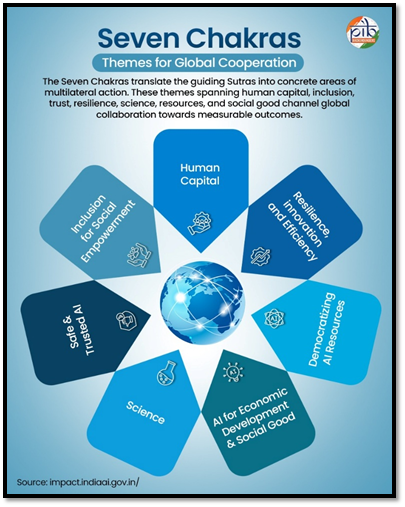

Together, these Chakras provide a comprehensive framework for countries, international organisations, and stakeholders to align AI strategies, promote shared learning, and deploy AI solutions that maximise collective benefits while addressing common challenges.
AI Impact Events at the Summit
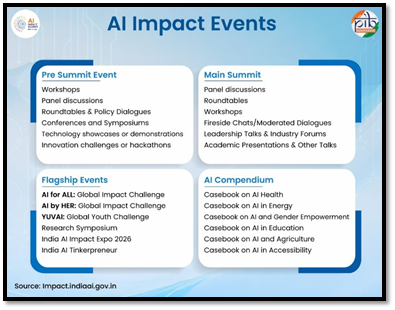

The objectives of the India–AI Impact Summit 2026 are operationalised by the AI Impact Events. The events provide structured platforms to present Indian AI initiatives, sectoral use cases, and institutional frameworks, while enabling feedback, peer learning, and international benchmarking.
Pre-Summit Events
Pre-Summit Events have been organised as part of the preparatory process for the India–AI Impact Summit 2026 to facilitate early consultations and focused thematic discussions. These engagements, held in India and abroad, bring together governments, academic and research institutions, industry, startups, and civil society.
Regional AI Conferences
Regional AI Conferences are being organised as part of the lead-up to the India–AI Impact Summit 2026 to align national AI priorities with regional needs. Eight conferences held between October 2025 and January 2026 across Meghalaya, Gujarat, Odisha, Madhya Pradesh, Uttar Pradesh, Rajasthan, Kerala, and Telangana, partnered with state governmentswill identify region-specific AI use cases, policy inputs, and capacity gaps. The deliberations will inform the agenda and outcomes of the India–AI Impact Summit 2026.
Main Summit
The Main Summit will be organised across the seven Chakras of the Summit. These sessions will bring together industry, academia, and international partners to examine use cases, share policy experiences, and identify practical approaches for development-oriented deployment of AI. The strong global response to the Summit is reflected in the receipt of over 700 proposals.
AI Compendium
The AI Compendium is a key knowledge output of the India–AI Impact Summit 2026 and will be released during the Summit on 17 February 2026. It comprises a set of thematic casebooks documenting real-world applications of Artificial Intelligence across priority sectors. It will serve as a reference resource for practitioners, and stakeholders, and support continued collaboration and adoption of responsible and development-oriented AI solutions beyond the Summit.
Flagship Events
- AI for ALL: Global Impact Challenge is aimed at identifying AI solutions with potential for large-scale impact. Implemented in partnership with Startup India under the Department for Promotion of Industry and Internal Trade, Ministry of Commerce and Industry, and the Digital India Bhashini Division, the Challenge invites participation from students, working professionals, researchers, and startups. It focuses on widely deployable AI solutions across sectors such as urban infrastructure and mobility. Selected solutions will be showcased at the Summit, with awards up to INR 2.50 crore.
- AI by HER: Global Impact Challenge is aimed at promoting women-led innovation in AI. Implemented in partnership with NITI Aayog’s Women Entrepreneurship Platform, the Challenge invites women technologists to present AI solutions addressing large-scale and real-world public challenges. Selected solutions will be showcased at the Summit, with awards up to INR 2.50 crore.
- YUVAi: Global Youth Challenge is aimed at encouraging young innovators to develop AI solutions for real-world challenges. The Challenge invites participation from youth individuals and teams in the 13–21 age group. It is being implemented in partnership with MyBharat and the National Institute of Electronics and Information Technology, to bring their most innovative AI solutions to solve real-world problems. Selected participants will receive awards, with prizes worth up to INR 85 lakh.
- Research Symposium on AI and its Impact will be organised on 18 February 2026 at Bharat Mandapam, New Delhi, as part of the India–AI Impact Summit 2026, with IIIT Hyderabad as the knowledge partner. The Symposium will bring together researchers, the Global South, and the international community to present frontier research, exchange evidence, and foster collaboration on the impact of AI. It will feature plenary sessions, international research presentations, and Global South research and poster showcases.
- The India AI Impact Expo 2026 is being organised by the MeitY, with Software Technology Parks of India as the custodian. The expo is spread across over 70,000 square metres and is expected to host more than 150,000+ visitors and 400+ exhibitors across seven thematic pavilions. Designed as a business-focused platform, it will demonstrate the transition of Artificial Intelligence from research and pilots to large-scale deployment, bringing together innovators and investors to engage on AI solutions addressing sectoral and global challenges.
- India AI Tinkerpreneur is a national-level summer bootcamp aligned with the India–AI Impact Summit 2026, aimed at building AI and entrepreneurial capabilities among school students from Classes 6 to 12. The programme equips young learners with hands-on exposure to AI tools and technologies and encourages them to develop AI-enabled products and solutions addressing social-impact challenges. Through structured online sessions, mentorship by industry and academic experts, and guidance from ideation to execution, the initiative promotes innovation, problem-solving, and entrepreneurial thinking at an early stage.
Agenda of Events and Notable Attendees at the India-AI Impact Summit
Beginning with the India Innovation Festival, the programme builds momentum through policy panels, knowledge launches, research and industry sessions, and culminates in leader-level engagements and Global Partnership on AI (GPAI) Council meetings.
| Date | Event | Venue |
| 16–20 February 2026 | AI Impact Expo | Bharat Mandapam, New Delhi |
| 16 February 2026 | Keynotes, Panel Discussions, Roundtables | Bharat Mandapam/ Sushma Swaraj Bhawan/ Ambedkar Bhawan, New Delhi |
| 17 February 2026 | Release of Knowledge Compendiums on AI in Health, Energy, Education, Agriculture, Gender Empowerment, Accessibility | Bharat Mandapam, New Delhi |
| Seminar on Applied AI | ||
| AI by HER: Global Impact Challenge | Sushma Swaraj Bhawan, New Delhi | |
| Keynotes, Panel Discussions, Roundtables | Bharat Mandapam/ Sushma Swaraj Bhawan/ Ambedkar Bhawan, New Delhi | |
| 18 February 2026 | Research Symposium | Bharat Mandapam, New Delhi |
| Industry Session | ||
| AI by HER: Global Impact Challenge | Sushma Swaraj Bhawan, New Delhi | |
| Keynotes, Panel Discussions, Roundtables | Bharat Mandapam/ Sushma Swaraj Bhawan/ Ambedkar Bhawan, New Delhi | |
| Summit Dinner | Convention Centre, New Delhi | |
| 19 February 2026 | Opening Ceremony | Bharat Mandapam, New Delhi
|
| Leaders’ Plenary | ||
| CEO Roundtable | ||
| Keynotes / Panel Discussion/ Roundtables | Bharat Mandapam / Sushma Swaraj Bhawan / Ambedkar Bhawan, New Delhi | |
| 20 February 2026 | GPAI Council Meeting | Bharat Mandapam, New Delhi |
| Keynotes/ Panel Discussion/ Roundtables | Bharat Mandapam / Sushma Swaraj Bhawan / Ambedkar Bhawan, New Delhi |
*(Agenda as on 16 January, 2026)- The agenda is tentative and subject to revisions.
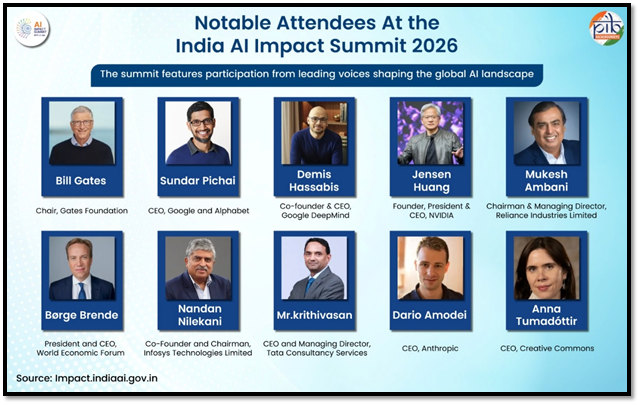

Key Institutional Frameworks Involved in the Summit
The India–AI Impact Summit 2026 is supported by core government institutions responsible for policy formulation, programme implementation, ecosystem development, and digital infrastructure. Their involvement provides administrative leadership, technical support, and institutional continuity, ensuring that the Summit is grounded in existing national initiatives and capable of translating discussions into actionable outcomes.
- Ministry of Electronics and Information Technology (MeitY)
MeitY provides overall policy direction for AI and digital technologies in India. The Ministry anchors the Summit within national priorities on artificial intelligence, electronics, digital governance, and trusted technology adoption. Its role ensures inter-ministerial coordination, alignment with state governments, and integration of Summit outcomes with ongoing national programmes and regulatory frameworks.
- IndiaAI Mission
IndiaAI Mission is a flagship mission supporting AI development in India. The Mission shapes the core themes of the Summit, including AI compute infrastructure, datasets, indigenous AI models, skilling, and startup support. It highlights ongoing government efforts to promote safe, responsible, and inclusive use of artificial intelligence.
- Software Technology Parks of India (STPI)
STPI supports the innovation and participation of startups, MSMEs, and innovators in the Summit. It provides incubation facilities, technical infrastructure, and industry linkages. Its network of centres across the country enables wider regional participation and supports growth of AI-driven enterprises.Its role connects AI innovators with industry, global markets, and export opportunities, strengthening India’s position in the global digital economy.
- Digital India Initiative
Digital India provides the foundational framework for large-scale AI adoption in India. Its emphasis on digital public platforms, inclusion, and citizen-centric governance is reflected in Summit themes. Digital India ensures AI solutions showcased at the Summit align with service delivery, accessibility, transparency, and public trust at national scale.
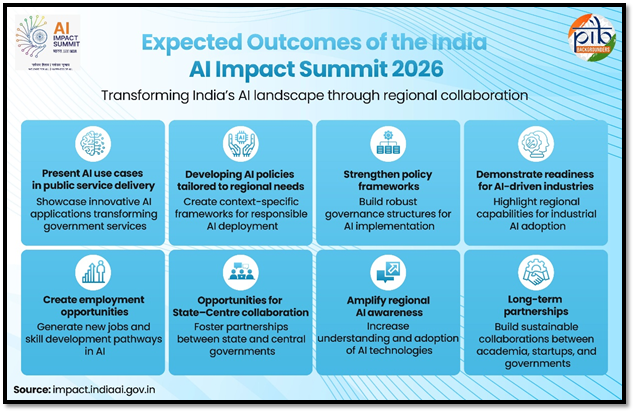

Expected Outcomes of the Summit
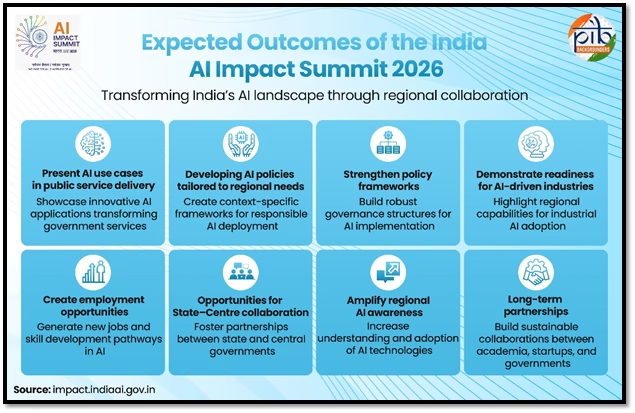
The India AI Impact Summit 2026 is expected to deliver focused, outcome-driven results aligned with national priorities. The Summit will emphasise practical AI deployment, policy alignment, and institutional coordination to support effective implementation across government and industry. It will strengthen governance and regulatory frameworks, assess regional preparedness for AI-led industrial growth, and promote skill development and workforce transition. The Summit will alsoexpand awareness and understanding of AI applications, and foster sustained partnerships among government, academia, startups, and industry to enable responsible and inclusive growth of the AI ecosystem.
Conclusion
The India–AI Impact Summit 2026 positions Artificial Intelligence as a strategic enabler for India’s development priorities. The Summit consolidates learnings from national and regional engagements to identify practical pathways for applying AI in governance, public service delivery, research, and industry. It supports the objectives of Digital India by strengthening the role of AI in digital public infrastructure, platform-based service delivery, and data-driven decision-making across sectors.The Summit reinforces the Digital India initiative by strengthening the role of AI within digital public infrastructure and technology-enabled service delivery. At the same time, it advances national self-reliance by emphasizing domestic capabilities in compute infrastructure, datasets, talent development, and indigenous innovation.