








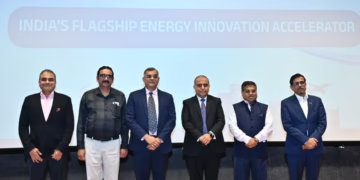







![[ L to R ]Mr. Rohan Ganapathy, Co-Chairman, CII National Committee on Space; Mr. Mallavarapu Apparao, Chairman, CII National Committee on Space; Ms. Jaya Choraria, Deputy Trade Commissioner for South Asia, UK; H.E. Mr. Antonio Bartoli, Ambassador of Italy to India; Dr. Pawan Goenka, Chairman, IN-SPACe; Dr V. Narayanan, Secretary, Department of Space; Chairman, Space Commission; and Chairman, ISRO; Mr. Shashwat Goenka, Vice President, CII; H.E. Mr. Philip Green OAM, High Commissioner of Australia to India; Mr. ISHII Yasuo, Senior Vice President, JAXA; Mr. Radha Krishnan A, Chairman and Managing Director, NSIL](https://24x7newsworld.com/wp-content/uploads/2026/09/Screenshot-2026-09-08-at-20-52-52-DSC_6125.JPG-JPEG-Image-6048-×-4024-pixels-—-Scaled-14_-360x180.avif)



















Tokyo, Japan, 26 June 2026 – Airbus has signed a Memorandum of Understanding (MoU) with Kawasaki Heavy Industries. Under the MoU, Airbus, in cooperation with Kawasaki Heavy Industries, will analyse opportunities to work on a Japanese anti-submarine warfare variant of the U950 Eurodrone, Europe’s first Large Long Endurance Remotely Piloted Aircraft System (RPAS). Japan has held observer status in the Eurodrone programme since 2023.
The Eurodrone is ideally suited for countries like Japan that need to monitor large maritime areas. Compared to its nearest competitor, Eurodrone has very long flight endurances and can fly with much more mission payload, including sonobuoys and torpedoes for anti-submarine warfare. With Eurodrone, Japan could complement its current crewed anti-submarine warfare fleet with a very efficient uncrewed platform and strengthen its maritime security in a sovereign and sustainable manner.
In the next step, Airbus will engage in discussions with Kawasaki Heavy Industries to develop options for the design, development, and commercialisation for a future Japanese maritime version of Eurodrone, including the definition of possible configurations, integration of Japanese sensors and effectors, and other potential workshare for Japanese industry during production and sustainment. All this is intended to ensure that Japan can operate the Eurodrone sovereignly and without restrictions, should the country decide to acquire the RPAS.
This targeted collaboration with Japan is set to bolster the Eurodrone programme while deepening the strategic framework of European-Japanese defense initiatives. Furthermore, insights gained from developing Japan’s specific variant are expected to provide substantial operational and logistical advantages for future European naval versions of Eurodrone.
Eurodrone: Long endurance and broad mission portfolio
The Eurodrone, a 4-nation programme of Germany, France, Italy and Spain, led by the Organisation for Joint Armament Cooperation (OCCAR), is currently under development and is scheduled to take its first flight in 2029. India is also an observer in the programme. The Eurodorne can cover a wide range of missions – from airborne intelligence, surveillance, target acquisition, and reconnaissance to early warning and signals intelligence, as well as maritime patrol and anti-submarine warfare. With a mission payload (excluding fuel) of up to 2.3 tonnes it can stay airborne for up to 40 hours. It will be fully integrated in civil airspace and thanks to its high levels of safety and redundancy, it will be ideal to operate over the open sea.