







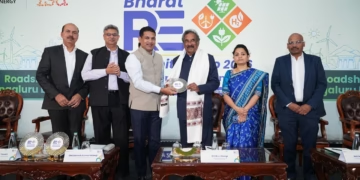
![[ L to R ]Mr. Rohan Ganapathy, Co-Chairman, CII National Committee on Space; Mr. Mallavarapu Apparao, Chairman, CII National Committee on Space; Ms. Jaya Choraria, Deputy Trade Commissioner for South Asia, UK; H.E. Mr. Antonio Bartoli, Ambassador of Italy to India; Dr. Pawan Goenka, Chairman, IN-SPACe; Dr V. Narayanan, Secretary, Department of Space; Chairman, Space Commission; and Chairman, ISRO; Mr. Shashwat Goenka, Vice President, CII; H.E. Mr. Philip Green OAM, High Commissioner of Australia to India; Mr. ISHII Yasuo, Senior Vice President, JAXA; Mr. Radha Krishnan A, Chairman and Managing Director, NSIL](https://24x7newsworld.com/wp-content/uploads/2026/09/Screenshot-2026-09-08-at-20-52-52-DSC_6125.JPG-JPEG-Image-6048-×-4024-pixels-—-Scaled-14_-360x180.avif)



















![[ L to R ]Mr. Rohan Ganapathy, Co-Chairman, CII National Committee on Space; Mr. Mallavarapu Apparao, Chairman, CII National Committee on Space; Ms. Jaya Choraria, Deputy Trade Commissioner for South Asia, UK; H.E. Mr. Antonio Bartoli, Ambassador of Italy to India; Dr. Pawan Goenka, Chairman, IN-SPACe; Dr V. Narayanan, Secretary, Department of Space; Chairman, Space Commission; and Chairman, ISRO; Mr. Shashwat Goenka, Vice President, CII; H.E. Mr. Philip Green OAM, High Commissioner of Australia to India; Mr. ISHII Yasuo, Senior Vice President, JAXA; Mr. Radha Krishnan A, Chairman and Managing Director, NSIL](https://24x7newsworld.com/wp-content/uploads/2026/09/Screenshot-2026-09-08-at-20-52-52-DSC_6125.JPG-JPEG-Image-6048-×-4024-pixels-—-Scaled-14_.avif)
India is building an open, capable and trusted ecosystem – “Make in India for the world”, inviting global partnerships across co-development, licensing, joint ventures, manufacturing and supply chains,” – Dr Pawan Goenka, Chairman, IN-SPACe
India must significantly expand its share of the global space economy; industry, start-ups and academia will be critical partners in achieving Space Vision 2047
Bengaluru, 7 September 2026: India’s ambitious space missions under Space Vision 2047 can be realised only through deeper collaboration among ISRO, industry, start-ups and academia, with each playing an integral role in advancing the country’s space ambitions, said Dr V. Narayanan, Secretary, Department of Space; Chairman, Space Commission; and Chairman, ISRO, at the inauguration of the 9th Bengaluru Space Expo (BSX) 2026.
Delivering the inaugural address at the three-day international conference and exhibition, organised by the Confederation of Indian Industry (CII) in association with ISRO, IN-SPACe and NewSpace India Limited (NSIL) from 7–9 September 2026, under the theme “Harnessing Space for Global Progress: Innovation, Policy, and Growth”, Dr Narayanan said, “The Indian space ecosystem is growing exponentially with the collective strength of ISRO, space industry, entry of startups and international collaborations. Industrial collaboration and international partnerships are the way forward. India’s space programme must ultimately contribute to national development and the vision of Viksit Bharat 2047.”
“The overarching mission of India’s space programme is clear: to use space for national development and contribute to Viksit Bharat 2047. As our Prime Minister has emphasised, there should be no gap between the progress made in the space sector and the benefits that reach the common man. The ultimate measure of our success will be how effectively space technology improves people’s lives and contributes to the development of the nation,” he said.
“Our journey began with the launch of the Nike-Apache sounding rocket from Thumba in 1963, a rocket procured from the United States. Since then, India has come a long way, and ISRO has launched 434 foreign satellites from 34 countries. Today, we are working with international partners on a range of joint missions and programmes, demonstrating that space is an area where international cooperation can create value for all,” Dr. Narayanan added.
India Must Scale Up Its Global Space Footprint
Dr Narayanan stressed the need for India to significantly increase its share of the global space economy and expand both its space assets and launch capabilities.
“Our current share of the global space market is only around 2 per cent, which is very small for a country that has had a space programme for more than six decades. We need to dramatically expand our space assets and launch capability. When I joined ISRO in 1983, we were achieving roughly one launch in three years; today, we are moving towards a launch every month. Our ambition should be to reach around 50 launches a year,” he said.
Delivering the keynote address, Dr Pawan Goenka, Chairman, IN-SPACe, said Vikram-1, a defining milestone for India’s private space sector, is a powerful example of startup innovation working alongside the experience and support of ISRO and IN-SPACe.
He outlined India’s emergence as a full-spectrum space economy in which ISRO advances the frontiers of science, while private industry scales the manufacturing and launch of rockets and satellites. Achieving the national ambition of 50 launches annually will require wider technology transfers, strong private manufacturing and commercially operated infrastructure.
“India is building an open, capable and trusted ecosystem – “Make in India for the world”, inviting global partnerships across co-development, licensing, joint ventures, manufacturing and supply chains,” he said.
India–US Partnership Moving from Cooperation to Co-Creation
Addressing the inaugural session, H.E. Mr Sergio Gor, Ambassador of the United States to India, said, “Our partnership with India is no longer just about cooperation. It is about co-creation. We are no longer just sharing data. We are co-designing instruments, co-funding startups, and co-authoring the future of human discovery.”
Mr Shashwat Goenka, Vice President, CII, said India’s space sector is entering an exciting and transformative phase—moving beyond demonstrating capabilities to building a dynamic ecosystem capable of capturing opportunities in the global space economy.
“The applications of space technology are enormous, spanning agriculture, logistics, infrastructure, mining, energy and several other sectors. Industries must come forward to adopt space technologies and build new businesses around them,” he said.
“Wherever a satellite is built anywhere in the world, there should be an Indian company playing a role in it. Whenever a new space technology emerges, the Indian space sector should be ready to commercialise it and take it to the global market,” Mr Goenka added.
In his welcome address, Mr Mallavarapu Apparao, Chairman, CII National Committee on Space, said India’s space sector has evolved from primarily participating in design and manufacturing to developing and owning end-to-end capabilities.
This transformation, he said, has been enabled by the coming together of Government, the private sector, defence, industry, investors, academia and international partners.
Reflecting the sector’s rapid growth and expanding global engagement, Bengaluru Space Expo has emerged as a major international platform for the space industry in Asia. BSX 2026 has attracted participation from over 300 companies from 15 countries, along with more than 120 speakers and 15,000 delegates and visitors.
Mr Rohan Ganapathy, Co-Chairman, CII National Committee on Space, said India’s private space sector has witnessed remarkable growth over the past decade.
“From just one private space-tech company in 2012, the country today has more than 400 companies operating across the space value chain, ranging from launch vehicles and Earth observation systems to downstream applications. This growth reflects the emergence of a vibrant and increasingly diversified private space ecosystem in India,” he said.
“India has a significant opportunity to capture a larger share of this rapidly expanding global market by strengthening capabilities across the space value chain and enabling Indian companies to become globally competitive,” he said.
In his address, Mr. Radha Krishnan A, Chairman and Managing Director, NSIL, emphasised the need to scale indigenous capabilities, strengthen collaboration among industry, startups and academia, and translate space technologies into reliable, affordable solutions that create meaningful impact across agriculture, communications, disaster management, national security and other critical sectors.
Global Space Leaders Participate at BSX 2026
Mr. ISHII Yasuo, Senior Vice President, JAXA, highlighted the JAXA–ISRO Lunar Polar Exploration mission (LUPEX), being taken up with the participation from NASA and European Space Agency, which aims to conduct in-situ observations of water at the Moon’s South Pole. He also showcased ongoing industry cooperation across ground stations, space debris management, lunar exploration and satellite data utilisation, while identifying Earth observation, supply chains and co-funded businesses as areas for deeper collaboration.
Ms. Jaya Choraria, Deputy Trade Commissioner for South Asia, UK, in her address, pointed out the growing strength of the UK–India space partnership. “With the UK-India Free Trade Agreement and Vision 2035 creating new avenues for collaboration, the opportunity to build partnerships across advanced manufacturing, satellite technologies, Earth observation, space sustainability and downstream services is growing exponentially,” she said.
H.E. Mr. Philip Green OAM, High Commissioner of Australia to India, highlighted Australia’s support for the Gaganyaan mission through a dedicated tracking terminal on the Cocos (Keeling) Islands. He emphasised that Australia’s technological strengths, strategic geography and innovation ecosystem complement India’s manufacturingscale, cost efficiencies and engineering talent, making the two countries natural partners in space.
H.E. Mr. Antonio Bartoli, Ambassador of Italy to India, described space as a key pillar of the India-Italy Special Strategic Partnership and Joint Strategic Action Plan. Building on more than 25 years of cooperation between ISRO and the Italian Space Agency, he outlined five focus areas: inter-agency engagement, scientific research, multilateral coordination, business partnerships and a stronger institutional framework.
BSX 2026 Brings the Global Space Ecosystem Together
The BSX 2026, inaugurated today, features participation from more than 250 companies representing a diverse cross-section of the global space ecosystem.
The exhibition showcases capabilities across aerospace and defence; satellites and spacecraft manufacturing; launch vehicles and services; space equipment, components and accessories; ground systems and infrastructure; geospatial solutions and data analytics; telecommunications and connectivity; research and academia; space agencies and government departments; advanced manufacturing; and specialised support services.