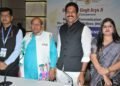






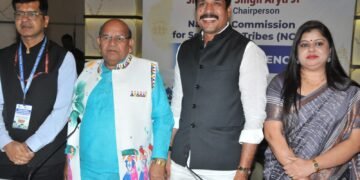




















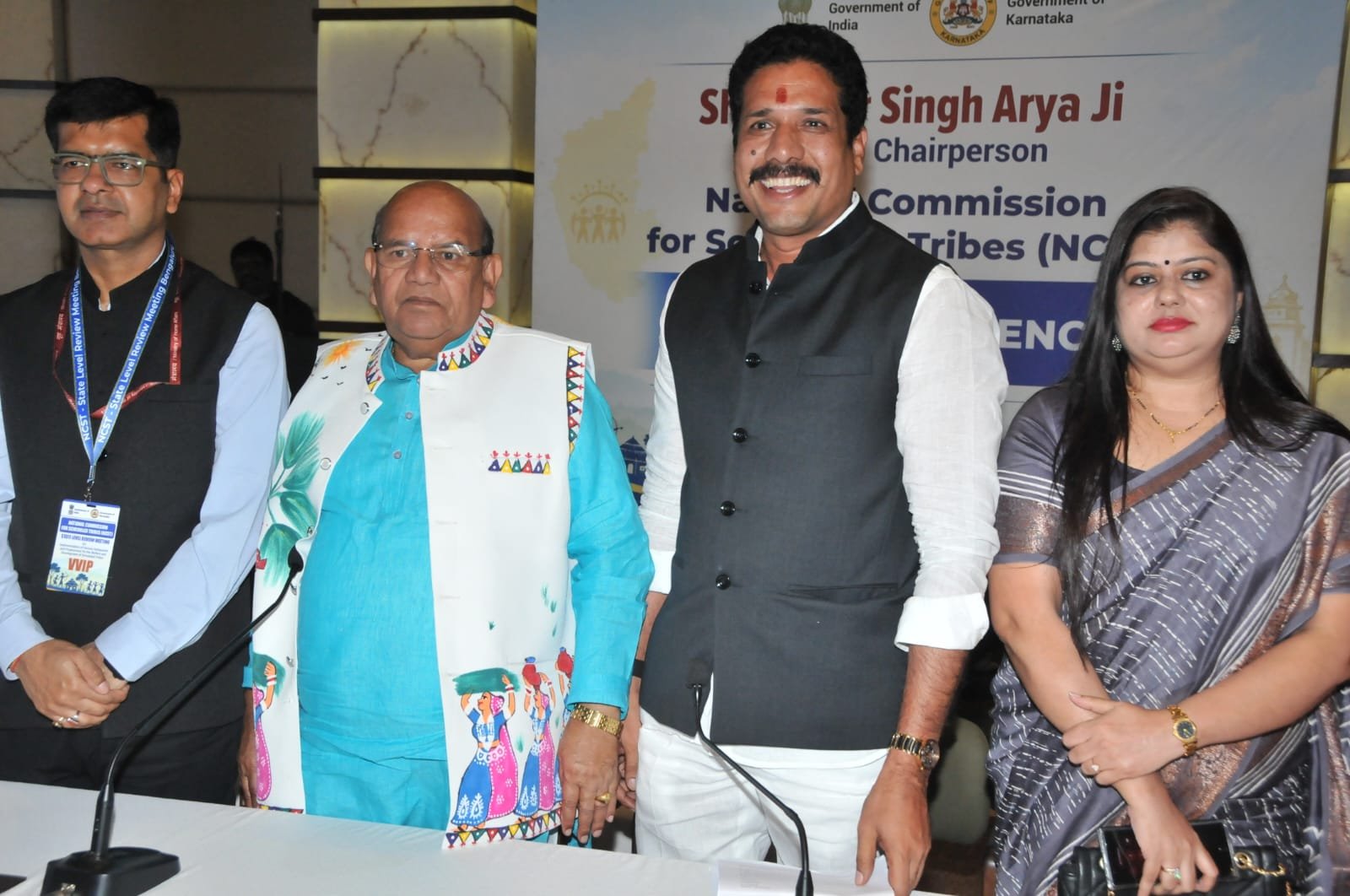
Anthar Singh Arya, Chairman, National Commission for Scheduled Tribes
Bangalore, September 24 (Karnataka News):
Addressing a press conference after a progress review meeting held at a private hotel in the city on the implementation of various programs for the development of the Scheduled Tribe community in the state and the measures being taken for the safety of the communities, he said that the National Commission for Scheduled Tribes (NCST) has been constituted under Article 338A of the Constitution of India to protect the interests of the Scheduled Tribes.
The Commission is empowered to monitor the functioning of constitutional and statutory safeguards for various programmes for the development of the Scheduled Tribes community by the Central and State Governments, review development programmes and make recommendations to the Central and State Governments for the protection, welfare and socio-economic development of the Scheduled Tribes.
As per clause (5)(d) of Article 338A, annual reports of the Commission on the functioning of these safeguards and on such other occasions as the Department may deem fit shall be submitted to the Hon’ble President of India.
The Commission will have to undertake a comprehensive review of the implementation of constitutional protections, welfare measures and development programmes for the Scheduled Tribes in the States/UTs. For this purpose, state level review meetings are being held in line with the existing schemes and programmes of the government, he said.
The Commission has been touring South India for the past three days, and a progress review meeting was held in Tamil Nadu yesterday and the day before. This tour is part of the Prime Minister’s special campaign to present the actual situation to the Central Government.
During this tour, discussions are being held with senior government officials and police officials, including the youth of the Scheduled Tribes, on the implementation of government schemes, including local issues, with the general public. A meeting was held today with the Chief Secretary and other senior officials of the government regarding the implementation of Karnataka government schemes, and a review was held on the schemes of the Scheduled Tribes.
The meeting mainly directed the government to seriously consider the complaints filed at the district level regarding the Scheduled Tribes. The biggest problem here is that there are 7% of Scheduled Tribes here but the reservation is only 3%, unfortunately, it has been directed to increase it to 7%.
For proper justice, a complaint can be filed at the Central Government’s https://ncstgrams.gov.in/public/Home.aspx . The Commission is always with the people for proper justice. Whenever any development work is implemented, the first problem is faced by the people of the Scheduled Tribes, who are being marginalized in the name of development. The Commission is aware of this.
The lack of Panchayat elections here is also a big problem. He said that a visit will be made to the area within a month to listen to the problems of the Scheduled Tribe people there regarding the implementation of the Kasturi Rangan report.
Commission members Jatutu Hussain, Joint Secretary Amit Nirmal, Directors Purnendu Kant, Dr. P. Kalyana Reddy and Karnataka Public Relations Officer Jagadevi Hiremath were present at the press conference.
The National Commission for Scheduled Tribes held a meeting with senior officials of Canara Bank, the state-level lead bank, on September 23 and directed them to systematically implement bank schemes for Scheduled Tribes, monitor progress, and implement them.
Later, a meeting was held with the Scheduled Caste MLAs and Ministers. Public Works Minister Satish Jarkiholi, MP Kumar Nayak, MLAs Kamya. N. Rajanna, Basanagouda Daddal, Dr. Srinivas, Mrs. Karemma, Hemalaya Nayak spoke and said that the state government is formulating many programs for the welfare of the Scheduled Castes. The central government should also provide more assistance. In the state, 24.04 percent of the budget under the SCSP and TSP schemes is being allocated for the welfare of the Scheduled Castes and Tribes and projects are being implemented. In the same vein, the central government should also allocate funds for the welfare of the Scheduled Castes and Tribes in its budget, they appealed to the commission.
The reservation rate for Scheduled Tribes has been submitted to the Central Government to be increased to 7%, and assistance should be provided in this regard. The birth rate should be similarly monitored at the national level. Separate grants should be provided for the development of the Kalyan Karnataka region. Assistance should be provided for women empowerment. The rules of Eklavya Residential Schools should be relaxed and Eklavya Residential Schools should be recommended for the state, he requested.
Review of Constitutional Safeguards and Implementation of Development Schemes for Scheduled Tribes in the State of Karnataka
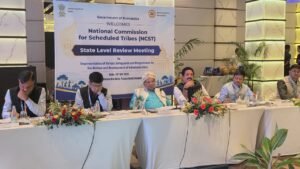
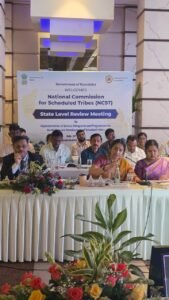
Bengaluru, 24 September 2026: The National Commission for Scheduled Tribes (NCST) today undertook a comprehensive review of the implementation of constitutional safeguards, welfare measures and development programmes for Scheduled Tribes in Karnataka at a review meeting held at the Conference Hall of Radisson Blu, Bengaluru.
The review meeting was chaired by Shri Antar Singh Arya, Hon’ble Chairperson, NCST, and was attended by Shri Jatothu Hussain, Hon’ble Member and Shri Amit Nirmal, Joint Secretary, NCST, and senior officers of the Commission.
The State Government was represented by the Chief Secretary, Director General of Police, Additional Chief Secretaries, Principal Secretaries and Secretaries of various departments, along with other senior officers. The review was undertaken on the basis of a structured and detailed questionnaire circulated by the Commission in advance, the information and data furnished by the Government of Karnataka, grievances and petitions received from members of the Scheduled Tribe communities, feedback received prior to the review meeting, and observations arising from field visits previously undertaken by the Commission in the State of Karnataka.
During the review, the Commission examined a wide range of issues concerning the Scheduled Tribes of the State, including implementation of constitutional safeguards, reservation and backlog vacancies, utilisation of funds under the ST Component, tribal land and forest rights, implementation of the Forest Rights Act, educational and welfare measures, and institutional mechanisms for protection of tribal interests.
The Commission particularly reviewed concerns relating to the rejection of a substantial number of claims under the Forest Rights Act, 2006, and emphasised the need for a comprehensive examination of rejected and pending claims in accordance with the provisions of the Act and Rules.
The Commission also discussed the proposal for establishment of an exclusive Karnataka State Commission for Scheduled Tribes for continuous monitoring of constitutional safeguards, along with measures for filling backlog vacancies and ensuring effective representation of Scheduled Tribes in education and public employment.
Special emphasis was placed on the socio-economic and infrastructure development of Particularly Vulnerable Tribal Groups (PVTGs), particularly the Koraga and Jenu Kuruba communities, with focus on health, nutrition, housing, education, livelihoods, land and forest rights and access to basic services.
The meeting provided an important platform for detailed interaction between the Commission and the State Government on the status of implementation of various safeguards and development measures. The discussions were constructive and fruitful, and the Commission urged the concerned departments to take appropriate and time-bound action on the issues raised during the review.
The NCST reiterated its commitment to ensuring that constitutional safeguards and welfare measures intended for the Scheduled Tribes translate into tangible and equitable outcomes on the ground.