











































Bengaluru, April 28 (Karnataka News):
Scientifically, to maintain ecological balance, a healthy city can only be built when there is 33% green cover. The green cover is decreasing in the growing Bengaluru city, and at least 10 crore trees need to be planted in the city of Bengaluru, which has a population of 1.40 crore, said Minister of Forests, Environment and Zoology Ishwara B Khandre.
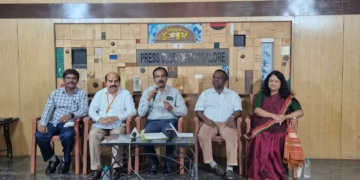
Speaking at the inauguration of a media workshop on ‘Temperature anomalies in Bengaluru and their impact’ organized by Karnataka Media Academy and Asar Social Impact Advisors at a private hotel in the city today, he said that science suggests that a person needs at least 7 trees to get good oxygen.
Speaking at length about the changes taking place in Bengaluru’s environment and the future plans of the Forest Department, he said that it is a matter of concern that Bengaluru, once known as a ‘retirement paradise’ and an ‘air-conditioned city’, is now turning into a concrete jungle.
He said that if Bengaluru experiences similar growth and increases in traffic, there is an immediate need to increase green cover to avoid it becoming a ‘gas chamber’ like New Delhi.
Restoration of past glory:
The Forest Department is committed to reclaiming the green Bengaluru built by Kempegowda. The Minister assured that stringent measures will be taken to restore the green cover around the city and prevent environmental pollution.
Pollution and degradation of lakes:
Many of the 250 lakes in Bengaluru have disappeared due to development, and some have been polluted with waste water. This is causing water and air pollution, which is having a negative impact on public health. He expressed concern that temperatures are rising due to traffic congestion and carbon dioxide emissions from vehicles.
Plantation of 11 crore saplings:
Sharing the achievements of the Forest Department, the Minister informed, “In the last three years, about 11 crore saplings have been planted across the state. I have instructed to conduct a scientific survey to find out how many of these saplings have survived and upload that report on the department’s website for public information.”
The Forest Department has formulated a mega plan to protect the ‘breathing spaces’ of Bengaluru, and has reclaimed forest land worth about ₹10,000 crore that was illegally encroached in strategic areas of the city, such as Kadugodi and Turahalli. The Karnataka Forest Department has taken a historic step to increase the green cover that is decreasing day by day in the Silicon City and maintain ecological balance.
Construction of ‘groves’ on reclaimed land:
Apart from just clearing the encroachments, the department has also formulated a master plan to prevent land grabbers from encroaching again. A compound will be immediately constructed on the reclaimed land and thousands of saplings will be planted to convert those areas into ‘Urban Forests’. These will act as natural centers that provide clean air to the city’s people, he said.
Bangalore will get another ‘Lalbagh’:
He said that a ‘Vishvaguru Basavanna’s Massive Biological Park’ will be built on a 153-acre area in Madappanahalli, Bengaluru North Taluk, in order to increase the green area of the city.
District level action plan to prevent climate change:
The ‘Karnataka State Action Plan’ prepared by the MPRI for environmental pollution control has received the government’s approval. Training and implementation processes will soon begin in all 31 districts of the state under the leadership of District Collectors to deal with climate change.
He said that our ultimate goal is to rebuild Bengaluru’s lakes and expand the city’s green belt with the motto “Vriksho Rakshith Rakshithah”.
He said that the Forest Department will take action if a detailed report is submitted on the topics presented by subject experts and discussed by media representatives at today’s workshop.
Mrs. Aayem Khanam, President of Karnataka Media Academy, welcomed the dignitaries and gave an introductory speech, saying that such an innovative workshop has been organized out of the responsibility of acting as a bridge between the media, which is responsible for reporting on the environmental changes and increasing heat in the changing city of Bengaluru and drawing the attention of the government, and the government.
In the current decade, the issue of global warming is attracting the attention of governments and is causing deaths and injuries to the common people. In addition to drawing the attention of the government to such a serious issue, today’s workshop will shed light on the awareness factors that the common people should follow. He said that a report will be submitted to the government for further action on the issues discussed and presented in this workshop of the Media Academy.
MS Diwakar, Director of the Karnataka State Natural Disaster Management Centre, who was the keynote speaker, said that environmental disasters are common occurrences. Currently, due to technology and media communication, they are becoming more newsworthy. When we look at history, we can see many documents.
Studies suggest that there will be less rainfall this year, and since it is a known fact that the temperature has increased, a report is already being prepared in partnership with IISc, Bangalore, on the steps that the general public should take during this hot weather to raise public awareness.
Karnataka is at the forefront of this in India by establishing DMC for the study of environmental changes in 1980 itself. Centers have been established in our state on a village-by-village basis, a system that is not found in any other state in India.
Journalists reporting on the sun say that the sun is not the same throughout the day. It records its maximum temperature at some point and then decreases. Similarly, the time it takes for the environment to heat up to that temperature in the sun and then cool down in the evening varies from region to region. In some places, it takes more time, in others, it takes less time. Based on that, the overall temperature has to be measured, he said.
Brikesh Singh, Chief Communications Officer, Asar Social Impact Advisors, participated in the workshop that began after the inauguration ceremony and gave an introductory speech on the topic ‘Purpose and Relevance of the Workshop’. He said that this workshop will shed light on the need for this discussion in the current social context and the future goals.
S. Swathi, Senior Fellow at IIHS, shed light on the reasons for the increasing population in Bengaluru and the situation in the city.
Heat Watch founder Aapekshitha Varshanay expressed concern about vulnerable groups affected by extreme heat.
Smt. Nithya J, Executive Engineer, BBMP’s Climate Action Cell, informed about the steps the city needs to take to combat rising temperatures.
A special interaction was held with outdoor workers suffering from the scorching heat, led by Bhargavi Nagendra of the ‘Socrates’ organization.
It was special to interact with media representatives after each concert.