














![[ L to R ]
Mr. Rohan Ganapathy, Co-Chairman, CII National Committee on Space; Mr. Mallavarapu Apparao, Chairman, CII National Committee on Space; Ms. Jaya Choraria, Deputy Trade Commissioner for South Asia, UK; H.E. Mr. Antonio Bartoli, Ambassador of Italy to India; Dr. Pawan Goenka, Chairman, IN-SPACe; Dr V. Narayanan, Secretary, Department of Space; Chairman, Space Commission; and Chairman, ISRO; Mr. Shashwat Goenka, Vice President, CII; H.E. Mr. Philip Green OAM, High Commissioner of Australia to India; Mr. ISHII Yasuo, Senior Vice President, JAXA; Mr. Radha Krishnan A, Chairman and Managing Director, NSIL](https://24x7newsworld.com/wp-content/uploads/2026/09/Screenshot-2026-09-08-at-20-52-52-DSC_6125.JPG-JPEG-Image-6048-%C3%97-4024-pixels-%E2%80%94-Scaled-14_-360x180.avif)


















Precision Manufacturing Ecosystem Emerging as Key Enabler for India’s Semiconductor Industry
India Targeting 200 Chip Design Companies as 400 Engineering Colleges and 105 Start-ups Gain Access to Industry-Grade EDA Tools
Five semiconductor manufacturing plants have commenced commercial production
Around 70,000 design engineers trained in four years; focus now to expand to system design and precision manufacturing
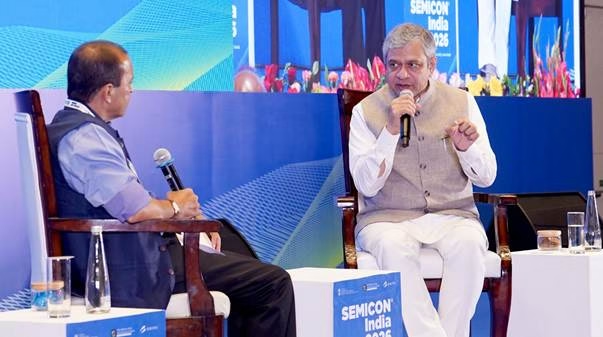
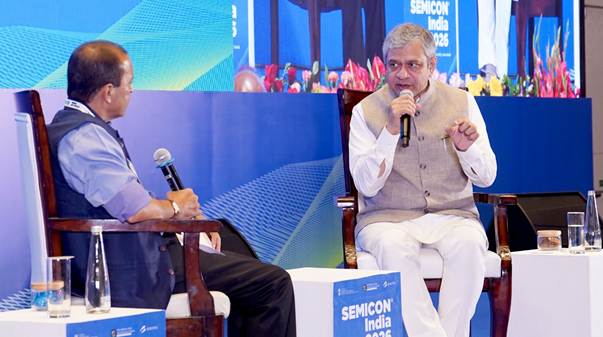
Union Minister for Electronics and Information Technology, Ashwini Vaishnaw, today said at SEMICON India 2026 that India’s semiconductor mission has moved from establishing the foundation to building the industry at scale. The next phase under India Semiconductor Mission (ISM) 2.0 will focus on developing a complete semiconductor ecosystem. Speaking at a fireside chat during SEMICON India 2026, Shri Vaishnaw said that ISM 1.0 focused on creating the foundational ecosystem, while ISM 2.0 will take the semiconductor industry forward across six key pillars – Design; Materials and Machines; More Fabs; More ATMP units; R&D; and Talent.
The Minister said that ISM 1.0, originally envisaged as a six-year programme, achieved its objectives in just four years, and expressed confidence that ISM 2.0 would similarly progress ahead of schedule, supported by strong and growing investor interest.
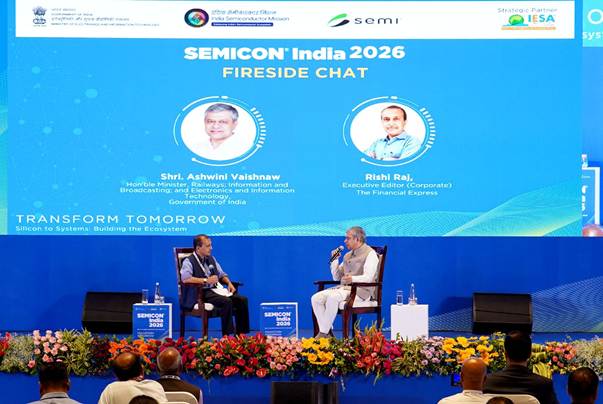

Five semiconductor manufacturing plants have commenced commercial production
Vaishnaw said that five plants manufacturing chips in India have commenced commercial production and the chips are being exported in addition to the domestic needs. He said this demonstrates the ability of Indian semiconductor manufacturing to compete on cost and quality, which are essential for competing in the global market.
The Minister said demand for semiconductor products is currently high and several companies are rapidly expanding production. He also noted that a fab scheduled to be commissioned in 2028 already has a large part of its capacity booked.
He said semiconductors and electronics are highly globalized industries, with components and products moving across international boundaries as part of global supply chains.
Design capability to drive semiconductor ecosystem
Highlighting design as one of India’s major strengths, Vaishnaw said the country’s design capability rooted in the IT industry and global capability centres, is now extending into the semiconductor sector. The Minister estimated at least 200 chip design companies emerging under ISM 2.0, calling it “a game changer” for building homegrown semiconductor IP.
The Minister said the first phase of support for chip-design startups in ISM 1.0 focused on addressing the high cost of Electronic Design Automation (EDA) tools. More than 105 chip design startups gained access to state-of-the-art EDA tools through the initiative, while 20 startups received venture capital funding.
He acknowledged the progress of startups in the sector, including chips being developed for products, has encouraged the expansion of the programme and greater participation from larger companies and Indian-origin engineers working globally.
Precision manufacturing and applied R&D
Vaishnaw said the electronics manufacturing ecosystem has helped develop precision manufacturing capabilities, particularly among MSMEs, which are now supporting multiple sectors including electronics, mobile manufacturing, aerospace, aviation, defence and semiconductors.
He said the next focus should be on applied R&D within manufacturing plants, aimed at improving product quality and manufacturing processes.
The Minister also highlighted the need to develop skills for precision manufacturing. He said a multi-level training model is being developed, to meet the requirement of skilled personnel for the precision manufacturing ecosystem.
70,000 design engineers trained in four years
On semiconductor skilling, Vaishnaw said India had initially set a target of training 85,000 design engineers in 10 years and has already trained around 70,000 design engineers within four years.
He said students from around 400 engineering colleges, including institutions in smaller cities, have received access to industry-grade EDA tools. Students are also getting opportunities to take their designs through tape-out and see their ideas developed into products.
Under ISM 2.0, the focus on skilling will move beyond chip design towards system design, with the objective of creating talent that is highly sought after by the industry.
The Minister also said the demand for cleanroom technicians and maintenance personnel is increasing, and that the target of training one lakh technicians under ISM 2.0 may need to be increased in view of industry demand.

Electronics, AI and semiconductor ecosystem growing together
Vaishnaw said electronics, semiconductors and AI applications are closely interconnected. He highlighted the growing manufacturing ecosystem for AI servers and said major server manufacturers are showing interest in setting up manufacturing in India.
He said the ecosystem covering components, finished products, laptops, servers and accessories is gradually taking shape, and once the ecosystem is established, growth can become more consistent.
India’s design capability and trusted ecosystem
The Minister said India’s design capability is an important advantage in building a stronger semiconductor ecosystem and enabling greater localisation.
He also highlighted India’s position as a trusted country and the importance of trust and IP protection in attracting global semiconductor and electronics companies.
Vaishnaw said companies which had previously not established operations outside their parent country are now coming to India, describing this as an important indication of the confidence being placed in India’s capabilities.
Towards Made-in-India and designed-in-India chips
Vaishnaw said India is progressing systematically towards becoming a product nation. He noted that some of the chips being developed in India are already being used in strategic sectors, while chips are also being exported.
He said many more Made-in-India and designed-in-India chips are expected to emerge over the course of the semiconductor programme.
The Minister said ATMP units are already exporting to Japan, while chips are also being incorporated into products exported to USA and EU countries such as Switzerland and Germany.