

























In past 12 years, the Government of India has significantly strengthened India’s health system. Quality healthcare is more accessible, more affordable, and more equitable than it has ever been. This aligns with the principle of “Sabka Saath, Sabka Vikas, Sabka Vishwas and Sabka Prayas” to build an Atmanirbhar Bharat.
Ayushman Bharat
- The Ayushman Bharat Pradhan Mantri Jan Arogya Yojana (AB-PMJAY) provides health insurance of Rs. 5 lakh per family per year to families from the poorest 40% of society and all senior citizens aged 70 and above.
- Over 40,000 claims are processed every single day for over 1,900 treatment packages.
- Since the scheme launched in 2018, as of August 12, 2026:
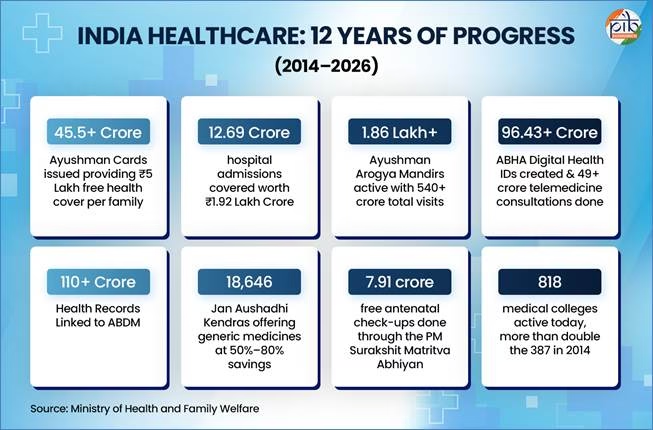
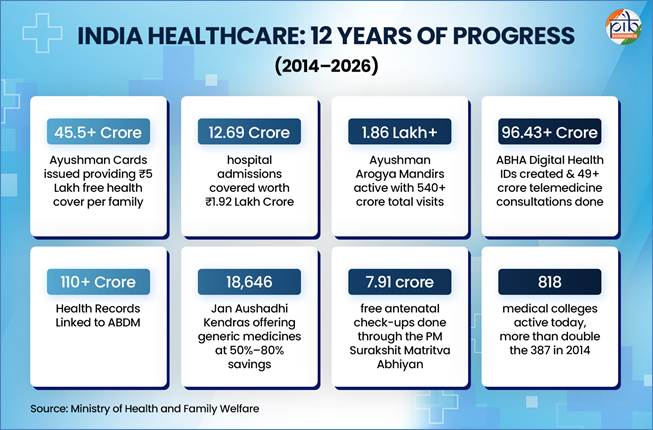
- Over 45.5 crore Ayushman Cards have been issued
- 12.69 crore hospitalizations have been covered, amounting to Rs. 1.92 lakh crore (as on June 30, 2026)
- Over 38,466 public and private hospitals are empanelled
- 1.20 crore senior citizens enrolled under the Ayushman Bharat Vay Vandana scheme. Over 13.84 lakh treatments, worth Rs. 3,000-crore have been availed.
- Under AB PM-JAY, 29.05 lakh inter-state portability hospital admissions, amounting to more than Rs. 8,383.97 crore, have been authorised (as on June 30, 2026)
- Over 1.86 lakh Ayushman Arogya Mandirs (AAMs) are now functional across the country to provide primary healthcare at every neighbourhood (As of 12 August 2026). These centres offer 12 free services and have recorded a cumulative footfall of over 540 crore till date.
- The Pradhan Mantri Ayushman Bharat Health Infrastructure Mission (PM-ABHIM):
- Support for 23,224 rural health and wellness centres in 10 high-focus states.
- Establishing 13,736 urban health and wellness centres in all states.
- 3,389 block public health units in 11 high-focus states.
- Setting up 744 integrated public health labs in all districts.
- Establishing 631 critical care hospital blocks in all districts with a population of more than 5 lakh.
- And underpinning all of this is India’s digital health backbone, the Ayushman Bharat Digital Mission (ABDM). Coverage under ABDM (as of August 12, 2026):
- 96.43 crore ABHA health identity numbers created
- Over 110 crore health records have been linked with ABHA
- Over 5.47 lakh health facilities have been registered on the platform
- More than 10.50 lakh healthcare professionals have been registered on the platform.
National Health Mission: Targeted Health Interventions
The National Health Mission (NHM), with its two sub-missions-National Rural Health Mission and National Urban Health Mission, delivers targeted programmes that address specific diseases, populations, and health challenges. NHM has significantly improved public health outcomes across maternal and child health, disease elimination, and immunisation.
Maternal and Child Health: Making Safe Births the Norm-
- The Pradhan Mantri Surakshit Matritva Abhiyan has enabled over 7.91 crore free antenatal check-ups.
- More than 1.24 crore high-risk pregnancies have been identified.
- First-trimester antenatal registration in India increased from 58.6% in NFHS-4 (2015-16) to 76.2% in NFHS-6 (2023-24).
- Mothers receiving four or more antenatal care visits in India increased significantly from 51.2% in NFHS-4 (2015-16) to 65.2% in NFHS-6 (2023-24).
- Institutional deliveries in India increased from 78.9% in NFHS-4 (2015-16) to 90.6% in NFHS-6 (2023-24).
- On immunisation, the Universal Immunisation Programme reaches 2.67 crore newborns and 2.9 crore pregnant women every year with free vaccines against 12 diseases.
- Mission Indradhanush, launched in 2014, has functioned as a catch-up drive, vaccinating 5.46 crore children and 1.32 crore pregnant women across its various phases.
- The percentage of zero-dose children-those who had received no vaccines at all-dropped from 0.11% of the population in 2023 to 0.06% in 2024.
- Under Universal Immunisation Programme (UIP), the government launched U-WIN in October 2024 — a platform that ensures no family loses its vaccination records. As of March 2026, 11.87 crore children and 3.96 crore pregnant women are already registered.
- In February 2026, the government launched a three-month campaign to provide free HPV vaccines to 1.2 crore girls aged 14 years, for combating cervical cancer.
- 52,10,302 girls have received the HPV vaccine across the country (as on July 15, 2026).
- These initiatives have improved various mortality rates, including:
- Maternal mortality rate declined to 87 per 1,00,000 live births in 2022-24 from 130 per 1,00,000 in 2014-16.
- Neonatal mortality rate declined to 17 per 1,000 live births in 2023 from 28 per 1,000 live births in 2015.
- Under-5 mortality rate declined to 28 per 1,000 live births in 2023 from 48 per 1,000 live births in 2015.
Eliminating Communicable Diseases: Real Progress on Long-Standing Burdens
- The government has reduced the prevalence of communicable diseases over the past 12 years.
- New cases of tuberculosis emerging yearly in India dipped by 21% from 2015-2024; mortality due to TB dropped by 28% during the same period.
- Treatment success rates in Tuberculosis have climbed from 83% in 2021 to 90% in 2025 — and treatment coverage has gone from 53% (2015) to 92% (2024).
- More than 28.1 crore people have already been screened, 20 Lakh people given preventive treatment, and 5.7 lakh new Nikshay Mitras have been added so far under the intensified campaigns since December 2024.
- Malaria cases and deaths have fallen by 80.5% and 78.38% respectively between 2015 and 2023. India exited the WHO’s ‘High Burden to High Impact (HBHI) group’ for malaria in 2024.
Non-Communicable Diseases: Catching Problems Early
- National Programme for Prevention and Control of Non-Communicable Diseases (NP-NCD) focuses on strengthening infrastructure, human resource development, screening, early diagnosis, referral, treatment, and health promotion for Non-Communicable Diseases (NCDs). Through nationwide screening drives:
- 41.5 crore Screened for hypertension
- 41.3 crore for diabetes
- 35.3 crore for oral cancer and
- 16.5 crore for breast cancer.
- The Pradhan Mantri National Dialysis Programme (launched 2016) has provided free dialysis to 32.44 lakh patients across 1,856 centres (as of June, 2026).
- Under the Strengthening of Tertiary Cancer Care Centres Facilities Scheme, 19 State Cancer Institutes (SCIs) and 20 Tertiary Cancer Care Centers (TCCCs) have been approved.
- Under the National Programme for Prevention and Control of Non-Communicable Diseases, 770 District NCD Clinics, 524 Day Care Cancer Centres (DCCCs) and 6,410 NCD clinics at Community Health Centres have been set up across the country.
- India has achieved a 17.3% relative reduction in overall tobacco use from 2009-10 to 2016-17, as per the Report of the second round of the Global Adult Tobacco Survey (GATS- 2).
- To achieve a tobacco-free generation, the Government launched the Tobacco Free Youth Campaign in 2023 — now in its third edition. This work has earned India the 2025 Bloomberg Philanthropies Award for tobacco control.
Making Medicines and Tests Actually Affordable-
- The Pradhan Mantri Bharatiya Janaushadhi Pariyojana (PMBJP) has made generic medicines cheaper. The Jan Aushadhi Kendras, where these medicines are available, have grown from a handful of stores in 2014-15 to over 18,646 Jan Aushadhi Kendras as of February 2026.
- These medicines are sold at 50–80% below branded prices, with a basket of over 2,000 medicines and 300 surgical devices.
- AMRIT (Affordable Medicines and Reliable Implants for Treatment) Pharmacies launched in 2015, go even further, offering life-saving medicines at discounts of 50–90%, making treatment affordable for low-income patients who would otherwise go without treatment.
- The scheme has benefited more than 6.85 crore patients and medicines worth over Rs. 17,000 crore at MRP have been dispensed so far, resulting in cumulative savings of about Rs. 8,400 crore for patients.
- Free Diagnostics Service Initiative under NHM makes tests, X-rays, blood work free at every level of the public health system from sub-centres all the way up to district hospitals, spanning haematology, radiology, biochemistry, and more.
- Diagnostics services are provided free of cost at all levels of public health facilities
- 14 tests at Sub Centers
- 63 at Primary Health Centers
- 97 at Community Health Centres
- 111 tests at Sub District Hospitals
- 134 tests at District Hospitals.
- Diagnostics services are provided free of cost at all levels of public health facilities
Reaching People Where They Are: Digital Health and Telemedicine
- eSanjeevani, India’s national telemedicine platform, has delivered over 49 crore consultations since its launch in 2019 (as on August 11, 2026). Over 2.4 lakh healthcare providers are now on the platform.
- Tele-MANAS — launched in October 2022 — was introduced as a toll-free helpline (14416) available nationwide, offering a wide range of mental health services.
- It operates in 20 languages across all 36 states and union territories. It has already received 43.64 lakh calls since the launch of the service, through 53 Tele-Manas Cells and 23 Mentoring Institutes (as on August 11, 2026).
- i-DRONE service launched in 2021 is delivering medicines and vaccines by drone. 22,000 medicines have been delivered over 7,700 kilometres through 65 healthcare centres.
- AI is now also embedded in care delivery. Between April 2023 and November 2025, 28.2 crore eSanjeevani consultations were supported by AI-enabled Clinical Decision Support Systems, providing real-time clinical alerts to doctors.
Building the Workforce India Needs
- Over the past 12 years, the number of medical colleges has more than doubled — from 387 to 818 allopathy colleges (as of 2025-2026).
- 12 new AIIMS have been made functional since 2014. There are 23 AIIMS now.
- MBBS and PG seats increased to 1,28,976 and 85,822, respectively, as of 2025-26.
- Nursing has received equal attention. 157 new nursing colleges are being set up, adding around 15,700 nursing graduates annually.
- B.Sc. Nursing seats are up 53% to 1,27,290, and M.Sc. Nursing seats up 39% to 14,986 as of June 2025.
Alternative Healthcare-
Alongside modern medicine, the government has formally integrated traditional healthcare systems into the public health framework. The Ministry of AYUSH (Ayurveda, Yoga & Naturopathy, Unani, Siddha, Sowa Rigpa, and Homeopathy), formed in November 2014, has established traditional medicines as an active part of India’s health system.
- 942 AYUSH institutions exist in the country as of May 2025.
- Ayush Grid is India’s digital bridge between traditional healing and modern healthcare delivery, making AYUSH more accessible, integrated, and future-ready. This AYUSH Grid will digitally connect all AYUSH hospitals and laboratories nationwide.