












































Bengaluru, August 11, 2026 —
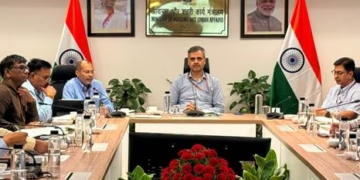
The Indian Marine Ingredients Association (IMIA) has submitted detailed representations to the Ministry of Commerce & Industry and Department of Fisheries, Government of India, in response to proposed policy interventions on the rationalisation of fishmeal for the aquaculture sector, urging a balanced, practical, and non-distortive approach.
IMIA underscored that the fishmeal and fish oil sector is a vital pillar of India’s marine economy, circular economy, and export ecosystem. The sector supports domestic aquaculture, generates export earnings, and converts low-value pelagic species, post-harvest losses, and fish-processing by-products into valuable marine ingredients.
While reaffirming its recognition of domestic aquaculture’s importance to India’s seafood value chain, the Association cautioned that export restrictions, domestic supply obligations, quota mechanisms, or price interventions could produce unintended consequences across the fishmeal value chain.
“The fishmeal and fish oil sector is deeply interconnected with India’s coastal economy, marine resource efficiency, and the future of Indian aquaculture. Any abrupt or distortionary intervention may harm not only industry stability, but also the livelihoods of millions linked to the small pelagic fishery,” said Dr. Sait, President, IMIA.
IMIA noted that the current rise in fishmeal prices is not unique to India but reflects a wider global market trend, with aquaculture producers worldwide facing elevated fishmeal costs. The Association maintained that the issue should not be addressed through domestic compulsion or trade distortion, and called instead for a focus on long-term expansion of raw material availability, efficiency improvements, and better waste utilisation.
The Association highlighted that the small pelagic fishery supports a large coastal population engaged in harvesting, landing, sorting, drying, transport, auctioning, handling, and processing. According to IMIA, any abrupt policy intervention that weakens price realisation in the fishmeal trade could adversely affect this livelihood chain, particularly vulnerable fishing and allied communities.
As an alternative to export bans, rigid quotas, or compulsory domestic supply obligations, IMIA has proposed that if intervention is considered necessary, domestic fishmeal prices could be aligned through a transparent benchmark-linked framework, set at around 10% below the prevailing international Peruvian market price — the benchmark most widely accepted and publicly available for the industry.
“The industry is prepared to facilitate periodic declaration of the true prevailing international Peruvian market price, to improve transparency and reduce artificial narratives around domestic pricing,” added [Name].
IMIA further noted that the industry has already demonstrated capacity for self-regulation in sustainability and market discipline, and that current concerns around fishmeal supply should be viewed in the broader context of rising concentration and regulatory gaps in the downstream feed market.
In its submission, IMIA maintained that a durable policy solution lies not in restrictive trade interventions but in expanding raw material availability through fish-processing waste utilisation, inland waste recovery, reduction of post-harvest losses, infrastructure support, responsible development of underutilised resources, whole value-chain standards, and sustainability-linked measures.
IMIA’S KEY POLICY POSITIONS
Opposes export restrictions, rigid quota systems, and domestic supply obligations.
As a fallback, if intervention is considered necessary, supports a transparent benchmark-linked domestic pricing framework rather than blunt restrictions.
Proposes, under that fallback framework, domestic fishmeal pricing at around 10% below the prevailing international Peruvian market benchmark.
Advocates long-term solutions through waste utilisation, infrastructure investment, efficiency gains, and sustainability-linked reforms.
Requests detailed consideration of IMIA’s representation by the GoI before any policy decision is taken.
IMIA has requested that its representation be considered in detail before any policy decision is taken. The Association reiterated its commitment to constructive engagement with policymakers to ensure that India’s aquaculture growth, marine ingredient industry, export competitiveness, and coastal livelihoods are protected through balanced, transparent, and sustainable policy measures.