




































Monday, February 16, 2026
24*7 News World
  • Home
  • World

    Maha Sivratri – World Yogi Day: Nandhiji’s Programs Emphasize Stillness, Awareness, and Inner Transformation

    In 2026 Malaysia targets 2.1 million tourist arrivals from India

    TOURISM MALAYSIA SIGNS PARTNERSHIP WITH MITSUI OUTLET PARK KLIA SEPANG FOR VISIT MALAYSIA 2026 (VM2026)

    Carlyle to invest INR 2,100 Cr (approximately USD 230M) in Nido Home Finance

    India Achieves Landmark Trade Victory, Unlocks $30-Trillion U.S. Market for Exports Across Key Sectors

    Levi’s® Brand Debuts “Behind Every Original” Campaign With Super Bowl Film Highlighting Backstories and Backsides

  • National
    • All
    • Economy & Politics
    • Election

    PM to inaugurate India AI Impact Expo 2026 on 16th February

    Maha Sivratri – World Yogi Day: Nandhiji’s Programs Emphasize Stillness, Awareness, and Inner Transformation

    Mahashivratri 2026:Visit Shri Kadu Malleshwara Swamy Temple and Sri Dakshinamukha Nandi Tirtha Kalyaani Kshetra

    International Dam Safety Conference in Bengaluru – CM Siddaramaiah to launch 2026 Dams are temples of modern India – CM Siddaramaiah

    Immerse in an Indulgent Celebration of Love at The Creek This Valentine’s

    Love, Thoughtfully Chosen: Valentine’s Day Gifts That Fit Everyday Life

  • Business

    India AI Governance Guidelines

    Raksha Mantri & his French counterpart to co-chair 6th Annual Defence Dialogue in Bengaluru

    SOURCE- Vedanta Limited

    Vedanta Delivers India’s Largest Employee Equity Grant in Manufacturing of ₹2,500 Crores

  • Health

    When Fashion Becomes a Force for Health: Suta Joins Sanjeevani’s Pink Tag Project for Breast Cancer Awareness

    As of 2nd February 2026, 53 Tele MANAS Cells have been set up in 36 States/ UTs

    PHOTO CREDIT-PHILIPS

    Philips named a Clarivate Top 100 Global Innovator for the 13th consecutive year

    Pullman Chennai Anna Salai Celebrates Pongal with a Farm-to-Fork Tamil Harvest Buffet Thursday,15th of Jan 2026-

    Breaking Barriers in Diabetes Care: Cipla Launches #InhaleTheChange Campaign

    Novo Nordisk A/S: Wegovy® pill approved in the US as first oral GLP-1 for weight management

  • Technology
    • All
    • Environment
    • Science

    India AI Stack: Powering Intelligence at Scale

    Unveiling the GAFX 2026 poster by  Shri Priyank Kharge, Hon’ble Minister for Information Technology, Biotechnology and Science & Technology, Government of Karnataka ,  Dr. Manjula N., IAS, Secretary to Government, Department of Electronics, IT, BT and Science & Technology, Government of Karnataka  Shri Rahul Sharanappa Sankanur , IAS, Director, Department of Electronics, Information Technology and Biotechnology, Govt. of Karnataka ,  Mr. Biren Ghose, President, ABAI, along with the ABAI team  at the Press Conference today.

    Government of Karnataka Announces “Bengaluru GAFX 2026”; Unveils ‘Evolution Reloaded’ Vision for AVGC and Creative Technologies

    KKR and Oak Hill Capital Commit Nearly $2 Billion to Leading European Data Center Platform Global Technical Realty

    Delta Electronics India to Provide 110 MW in Power Conditioning Systems to Prostarm Info Systems Ltd. for Multiple Energy Storage Projects in India

    Transforming India with AI

    India AI Impact Summit 2026 to focus on ‘Democratizing AI, Bridging the AI Divide’

  • Auto
    03.02.2026 
Art Basel Qatar 2026 x BMW 7 series and BMW X7. Photo: Alfardan Automobiles Co.

    BMW celebrates the inaugural edition of Art Basel Qatar.

    PHOTO CREDIT-TATA MOTORS

    Tata Motors registered total sales of 41,549 commercial vehicle units in January 2026

    PHOTO CREDIT-Mercedes-Benz

    For the first time, India enters the Top 5 global markets list for Mercedes-Maybach

    PHOTO CREDIT-PEUGEOT.

    PEUGEOT AND PATHÉ, AN UNPRECEDENTED PARTNERSHIP PROMOTING THE EXCELLENCE OF FRENCH CINEMA

  • Sports
    . 

    Tata Consultancy Services World 10K Bengaluru, the World’s premier 10K, is scheduled for Sunday, 26th April 2026; Registrations now open!

    BCCI congratulates India Under-19 team on sixth ICC Under-19 World Cup triumph

    Third stage of ticket sales commences as countdown to ICC Men’s T20 World Cup 2026 begins

    PHOTO CREDIT-TITAN

    Titan Smart introduces Celestor 2.0, onboards World No.3 Badminton pair, Chirag Shetty and Satwiksairaj Rankireddy as brand ambassadors

  • Entertainment

    UNDP Goodwill Ambassador and ‘Game of Thrones’ star Nikolaj Coster-Waldau highlights Odisha’s mangrove restoration story in global documentary series

    House of McDowell’s Soda Yaari Jam, India’s Biggest Branded Live IP, Touches down in Kolkata

    “Virgin Boys” – A Bold Telugu Youth Drama Captures Hearts Across Theatres

    Vogue Wedding Atelier presented by HSBC India at Taj Palace, New Delhi, from 8-10 August 2025

    A New Era in Luxury Weddings – Vogue Wedding Atelier Debuts in India

    GenS Life and Dowith Lit Present ‘Senior Spotlight’: Bengaluru’s Open Mic Celebration for the 55+

    PMJ Jewels Launches PMJ SuperStar Bracelet and ‘Celebrating Daughters’ Campaign

  • Lifestyle
    • All
    • Food
    • Travel
    Dubstep unveils its Valentine’s Day ‘Love on Loop’ campaign with the launch of the limited-edition Buzz X12 Love Edition earbuds, available exclusively on Instamart. #madetoplay

    Celebrate Valentine’s with Dubstep®’s Love on Loop—Win a Trip for Two to Goa and More

    As of 2nd February 2026, 53 Tele MANAS Cells have been set up in 36 States/ UTs

    PHOTO CREDIT-PHILIPS

    Philips named a Clarivate Top 100 Global Innovator for the 13th consecutive year

    LINDBERG Unveils an Exclusive Lunar New Year Precious Special Edition

    Pullman Chennai Anna Salai Celebrates Pongal with a Farm-to-Fork Tamil Harvest Buffet Thursday,15th of Jan 2026-

    PHOTO CREDIT-Malaysia Aviation Group

    Malaysia Airlines Celebrates Resumption of Direct Flights to Chengdu,Strengthening Connectivity to Western China 

No Result
View All Result
24*7 News World
  • Home
  • World

    Maha Sivratri – World Yogi Day: Nandhiji’s Programs Emphasize Stillness, Awareness, and Inner Transformation

    In 2026 Malaysia targets 2.1 million tourist arrivals from India

    TOURISM MALAYSIA SIGNS PARTNERSHIP WITH MITSUI OUTLET PARK KLIA SEPANG FOR VISIT MALAYSIA 2026 (VM2026)

    Carlyle to invest INR 2,100 Cr (approximately USD 230M) in Nido Home Finance

    India Achieves Landmark Trade Victory, Unlocks $30-Trillion U.S. Market for Exports Across Key Sectors

    Levi’s® Brand Debuts “Behind Every Original” Campaign With Super Bowl Film Highlighting Backstories and Backsides

  • National
    • All
    • Economy & Politics
    • Election

    PM to inaugurate India AI Impact Expo 2026 on 16th February

    Maha Sivratri – World Yogi Day: Nandhiji’s Programs Emphasize Stillness, Awareness, and Inner Transformation

    Mahashivratri 2026:Visit Shri Kadu Malleshwara Swamy Temple and Sri Dakshinamukha Nandi Tirtha Kalyaani Kshetra

    International Dam Safety Conference in Bengaluru – CM Siddaramaiah to launch 2026 Dams are temples of modern India – CM Siddaramaiah

    Immerse in an Indulgent Celebration of Love at The Creek This Valentine’s

    Love, Thoughtfully Chosen: Valentine’s Day Gifts That Fit Everyday Life

  • Business

    India AI Governance Guidelines

    Raksha Mantri & his French counterpart to co-chair 6th Annual Defence Dialogue in Bengaluru

    SOURCE- Vedanta Limited

    Vedanta Delivers India’s Largest Employee Equity Grant in Manufacturing of ₹2,500 Crores

  • Health

    When Fashion Becomes a Force for Health: Suta Joins Sanjeevani’s Pink Tag Project for Breast Cancer Awareness

    As of 2nd February 2026, 53 Tele MANAS Cells have been set up in 36 States/ UTs

    PHOTO CREDIT-PHILIPS

    Philips named a Clarivate Top 100 Global Innovator for the 13th consecutive year

    Pullman Chennai Anna Salai Celebrates Pongal with a Farm-to-Fork Tamil Harvest Buffet Thursday,15th of Jan 2026-

    Breaking Barriers in Diabetes Care: Cipla Launches #InhaleTheChange Campaign

    Novo Nordisk A/S: Wegovy® pill approved in the US as first oral GLP-1 for weight management

  • Technology
    • All
    • Environment
    • Science

    India AI Stack: Powering Intelligence at Scale

    Unveiling the GAFX 2026 poster by  Shri Priyank Kharge, Hon’ble Minister for Information Technology, Biotechnology and Science & Technology, Government of Karnataka ,  Dr. Manjula N., IAS, Secretary to Government, Department of Electronics, IT, BT and Science & Technology, Government of Karnataka  Shri Rahul Sharanappa Sankanur , IAS, Director, Department of Electronics, Information Technology and Biotechnology, Govt. of Karnataka ,  Mr. Biren Ghose, President, ABAI, along with the ABAI team  at the Press Conference today.

    Government of Karnataka Announces “Bengaluru GAFX 2026”; Unveils ‘Evolution Reloaded’ Vision for AVGC and Creative Technologies

    KKR and Oak Hill Capital Commit Nearly $2 Billion to Leading European Data Center Platform Global Technical Realty

    Delta Electronics India to Provide 110 MW in Power Conditioning Systems to Prostarm Info Systems Ltd. for Multiple Energy Storage Projects in India

    Transforming India with AI

    India AI Impact Summit 2026 to focus on ‘Democratizing AI, Bridging the AI Divide’

  • Auto
    03.02.2026 
Art Basel Qatar 2026 x BMW 7 series and BMW X7. Photo: Alfardan Automobiles Co.

    BMW celebrates the inaugural edition of Art Basel Qatar.

    PHOTO CREDIT-TATA MOTORS

    Tata Motors registered total sales of 41,549 commercial vehicle units in January 2026

    PHOTO CREDIT-Mercedes-Benz

    For the first time, India enters the Top 5 global markets list for Mercedes-Maybach

    PHOTO CREDIT-PEUGEOT.

    PEUGEOT AND PATHÉ, AN UNPRECEDENTED PARTNERSHIP PROMOTING THE EXCELLENCE OF FRENCH CINEMA

  • Sports
    . 

    Tata Consultancy Services World 10K Bengaluru, the World’s premier 10K, is scheduled for Sunday, 26th April 2026; Registrations now open!

    BCCI congratulates India Under-19 team on sixth ICC Under-19 World Cup triumph

    Third stage of ticket sales commences as countdown to ICC Men’s T20 World Cup 2026 begins

    PHOTO CREDIT-TITAN

    Titan Smart introduces Celestor 2.0, onboards World No.3 Badminton pair, Chirag Shetty and Satwiksairaj Rankireddy as brand ambassadors

  • Entertainment

    UNDP Goodwill Ambassador and ‘Game of Thrones’ star Nikolaj Coster-Waldau highlights Odisha’s mangrove restoration story in global documentary series

    House of McDowell’s Soda Yaari Jam, India’s Biggest Branded Live IP, Touches down in Kolkata

    “Virgin Boys” – A Bold Telugu Youth Drama Captures Hearts Across Theatres

    Vogue Wedding Atelier presented by HSBC India at Taj Palace, New Delhi, from 8-10 August 2025

    A New Era in Luxury Weddings – Vogue Wedding Atelier Debuts in India

    GenS Life and Dowith Lit Present ‘Senior Spotlight’: Bengaluru’s Open Mic Celebration for the 55+

    PMJ Jewels Launches PMJ SuperStar Bracelet and ‘Celebrating Daughters’ Campaign

  • Lifestyle
    • All
    • Food
    • Travel
    Dubstep unveils its Valentine’s Day ‘Love on Loop’ campaign with the launch of the limited-edition Buzz X12 Love Edition earbuds, available exclusively on Instamart. #madetoplay

    Celebrate Valentine’s with Dubstep®’s Love on Loop—Win a Trip for Two to Goa and More

    As of 2nd February 2026, 53 Tele MANAS Cells have been set up in 36 States/ UTs

    PHOTO CREDIT-PHILIPS

    Philips named a Clarivate Top 100 Global Innovator for the 13th consecutive year

    LINDBERG Unveils an Exclusive Lunar New Year Precious Special Edition

    Pullman Chennai Anna Salai Celebrates Pongal with a Farm-to-Fork Tamil Harvest Buffet Thursday,15th of Jan 2026-

    PHOTO CREDIT-Malaysia Aviation Group

    Malaysia Airlines Celebrates Resumption of Direct Flights to Chengdu,Strengthening Connectivity to Western China 

No Result
View All Result
24*7 News World
No Result
View All Result
Home Business

India AI Governance Guidelines

FWM by FWM
February 15, 2026
in Business
0

Enabling Safe and Trusted AI Innovation

15 FEB 2026 11:12AM by PIB Delhi

Key Takeaways

  • India adopts a principle-based AI governance framework anchored in seven Sutras to enable safe, trusted, and inclusive AI innovation across sectors.
  • The guidelines recommends establishment of new national institutions including the AI Governance Group, Technology & Policy Expert Committee, and AI Safety Institute.
  • AI governance guidelines prioritises innovation over restraint, positioning AI as a catalyst for inclusive growth, competitiveness, and the vision of Viksit Bharat 2047.

Introduction

Artificial Intelligence has emerged as the defining force of the Fifth Industrial Revolution, and India has articulated a clear, ambitious vision: to build the full AI stack, anchored in national priorities. India’s AI strategy is not confined to technological prowess alone; it is rooted in democratisation, scale, and inclusion. The objective is to ensure that AI is not concentrated in a handful of firms or geographies, but diffused across agriculture, healthcare, education, governance, manufacturing, and climate action. By focusing on “AI for All,” India seeks to combine sovereign capability with open innovation—leveraging public digital infrastructure, indigenous model development, and affordable compute to drive productivity and inclusive growth. This approach aligns AI development with the broader aspiration of Viksit Bharat 2047, positioning AI as a catalyst for economic transformation, social empowerment, and strategic autonomy.

India’s achievements reflect this deployment-first philosophy. Under the IndiaAI Mission, over 38,000 GPUs have been onboarded through a subsidised national compute facility. AIKosh now hosts more than 9,500 datasets and 273 sectoral models, strengthening indigenous model development. The National Supercomputing Mission has operationalised 40+ petaflop systems, including AIRAWAT and PARAM Siddhi-AI. On the capacity front, IndiaAI and FutureSkills initiatives are supporting 500 PhDs, 5,000 postgraduates, and 8,000 undergraduates, while 570 AI Data Labs and 27 IndiaAI labs across states are expanding grassroots innovation. With nearly 90 per cent of startups integrating AI in some form, India is embedding AI deeply into its innovation ecosystem.

The India AI Governance Guidelines, releasing in AI Impact Summit 2026, arrive at a critical juncture to consolidate these gains. Anchored in seven guiding sutras, the framework adopts a principle-based, techno-legal approach. By establishing new institutions such as the AI Governance Group, the Technology & Policy Expert Committee, and the AI Safety Institute, India is institutionalising a whole-of-government model that balances innovation with safeguards. The guidelines strengthen India’s ambition to lead not only in AI adoption and capability, but also in responsible, inclusive, and trusted AI governance globally.

India’s AI Governance Philosophy

India seeks to harness the transformative potential of artificial intelligence for inclusive development and global competitiveness, while addressing the risks it may pose to individuals and society. To advance this objective, the Ministry of Electronics and Information Technology (MeitY) constituted a drafting committee in July 2025 to develop a framework for AI governance in India. The Committee was mandated to draw on existing laws, review global developments, examine available literature, and incorporate public feedback in framing suitable governance guidelines.

Based on its deliberations, the Committee presented the AI governance framework in four parts. The first part sets out the seven sutras that ground India’s AI governance philosophy. The second part examines key issues and offers recommendations. The third part presents an action plan, and the fourth part provides practical guidelines for industry actors and regulators to ensure consistent and responsible implementation of the recommendations.

Part 1: Key Principles

The key principles of the AI Governance framework have been carefully designed to ensure cross-sectoral applicability and technology neutrality, enabling relevance across diverse use cases and stages of technological evolution. Together, these principles provide a flexible and future-ready foundation for responsible AI development and deployment.

  1. Trust is the Foundation
  1. People First
Trust is essential to support innovation, adoption, and progress, as well as risk mitigation. Without trust, the benefits of artificial intelligence will not be realised at scale. Trust must be embedded across the value chain – i.e. in the underlying technology, the organisations building these tools, the institutions responsible for supervision, and the trust that individuals will use these tools responsibly. Therefore, trust is the foundational principle that guides all AI development and deployment in India. AI governance should place people at the centre. AI systems must be developed and deployed in ways that strengthen human agency and reflect societal values. From a governance standpoint, this requires that humans retain meaningful control over AI systems wherever possible, supported by effective human oversight. A people-first approach also emphasises capacity building, ethical protections, and safety considerations.
  1. Innovation over Restraint
  1. Fairness and Equity
AI-led innovation is a pathway to achieving national goals, such as socio-economic development, global competitiveness, and resilience. Therefore, AI governance frameworks should actively encourage adoption and serve as a catalyst for impactful innovation. That said, innovation should be carried out responsibly and should aim to maximise overall benefit while reducing potential harm. All other things being equal, responsible innovation should be prioritised over cautionary restraint.


Promoting inclusive development is a central objective of India’s AI governance approach. AI systems should therefore be designed and evaluated to ensure fairness and to avoid bias or discrimination, particularly against marginalised communities. At the same time, AI should be actively used to advance inclusion while reducing risks of exclusion and unequal outcomes.
  1. Accountability
  1. Understandable by Design
To ensure that India’s AI ecosystem progresses based on trust, AI developers and deployers should remain visible and accountable. Accountability should be clearly assigned based on the function performed, risk of harm, and due diligence conditions imposed. Accountability may be ensured through a variety of policy, technical, and market-led mechanisms.


Understandability is fundamental to building trust and should be a core design feature, not an afterthought. Though AI systems are probabilistic, they must have clear explanations and disclosures to help users and regulators understand how the system works, what it means for the user, and the likely outcomes intended by the entities deploying them, to the extent technically feasible.
  1. Safety, Resilience and Sustainability
AI systems should be designed with safeguards to minimise risks of harm and should be robust and resilient. These systems should have capabilities to detect anomalies and provide early warnings to limit harmful outcomes. AI development efforts should be environmentally responsible and resource-efficient, and the adoption of smaller, resource-efficient ‘lightweight’ models should be encouraged.

Together, these seven principles establish a coherent and balanced AI governance framework that enables innovation while safeguarding trust, equity, and accountability. They reflect India’s commitment to a people-centric, inclusive, and future-ready AI ecosystem. By aligning technological progress with societal values and developmental priorities, the framework provides a strong foundation for responsible AI adoption at scale.

Part 2: Key Issues and Recommendations

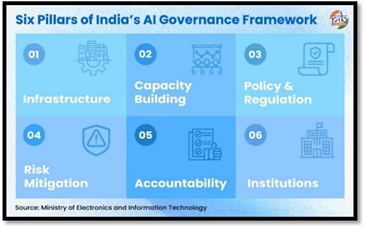
Using the seven principles or sutras as guidance, the Committee recommends an approach to AI governance that fosters innovation, adoption, and scientific progress, while proposing measures to mitigate the risks to individuals and communities. Effective governance includes not just regulation, but also other forms of policy engagement, including building capacity, infrastructure development, and institution building. The Committee has made recommendations across six pillars.  

  1. Infrastructure

India’s AI governance framework seeks to promote innovation and large-scale adoption while mitigating societal risks. Under the India AI Mission, significant progress has been made in strengthening core infrastructure, including improved access to compute and datasets, development of foundational models, and deployment of AI applications, building on Digital Public Infrastructure (DPI), enhanced data sharing, and safety testing. To sustain this momentum, continued investment in scalable infrastructure, equitable access to compute and data, and strong institutional capacity will be essential.

Foundational AI Infrastructure Ecosystem The Committee Further Recommends:
  • 38,000+ GPUs onboarded under IndiaAI Mission (target: 100,000), subsidised access via IndiaAI Compute Portal.
  • AIKosh hosting 9,500+ datasets and 273 sectoral models.
  • National Supercomputing Mission (40+ petaflops machines) including AIRAWAT & PARAM Siddhi-AI.
  • Ongoing AI integration with Digital Public Infrastructure (DPIs).
  • Empowering the India AI Mission and governments to expand AI adoption through infrastructure and compute access.
  • Improving data availability and sharing through strong data governance and portability standards.
  • Promoting locally relevant datasets to develop culturally representative AI models.
  • Ensuring access to evaluation datasets and compute for AI deployment and safety testing.
  • Integrating AI with DPI to enable scalable and inclusive deployment.


What is Digital Public Infrastructure?

Digital Public Infrastructure (DPI) refers to foundational digital systems that are accessible, secure, and interoperable, supporting essential public services. For example: Aadhaar, UPI, DigiLocker, Government e-Marketplace, UMANG, PM GatiShakti, among others.

  1. Capacity Building

India has launched multiple AI capacity-building initiatives, including IndiaAI FutureSkills, FutureSkills PRIME, and higher education programmes, laying a strong foundation for an AI-ready workforce. As AI adoption accelerates, further scaling these efforts will help meet the demands of inclusive growth and broader access. Expanding AI exposure for small businesses and citizens, alongside strengthening technical capacity within the public sector, will support effective procurement, risk management, and responsible deployment of AI systems.

Existing AI Human Resource & Innovation Capacity   The Committee Further Recommends:
  • Ongoing initiatives such as IndiaAI, FutureSkills are supporting 500 PhDs, 5,000 PGs, 8,000 UGs.
  • AI Data Labs Network consists of 570 labs across Tier-2 and Tier-3 cities to build grassroots AI capabilities through training in data annotation, curation, and applied AI skills
  • AI-linked curriculum is integrated under National Education Policy 2020
  • 27 IndiaAI Data and AI Labs established + 174 ITIs approved across 27 States/UTs.
  • YUVA AI for ALL free foundational course launched for mass AI literacy.
  • Enhancing public awareness and trust in AI through regular training programmes and awareness campaigns.
  • Training government officials and regulators to support informed procurement and responsible AI use.
  • Building capacity of law enforcement agencies to detect and address AI-enabled crimes.
  • Expanding AI skilling initiatives in vocational institutes and tier-2 and tier-3 cities.


  1. Policy & Regulation

The objective of the AI governance approach is to promote innovation, adoption, and technological progress while ensuring that risks to individuals and society are mitigated across the AI value chain. A review of the existing legal framework—comprising constitutional provisions, statutes, rules, regulations, and guidelines across domains such as information technology, data protection, intellectual property, competition, media, employment, consumer protection, and criminal law—indicates that many AI-related risks can be addressed under current laws.

At the same time, there is an urgent need for a comprehensive review of relevant laws to identify regulatory gaps relating to AI systems, including issues of classification and liability across the AI value chain, application of data protection principles to AI development, misuse of generative AI and challenges around content authentication and provenance, use of copyrighted material in AI training, and sector-specific risks in sensitive domains. While some of these issues are already under deliberation through inter-ministerial consultations, rulemaking, and expert committees, the rapid evolution of AI—including increasingly autonomous systems—poses challenges for regulatory frameworks to remain timely, coherent, and future-ready.

Policy Foundations for Responsible AI The Committee Further Recommends:
  • IndiaAI Mission (2025) for AI sovereignty, democratisation of compute access, indigenous model development, and responsible AI capacity building.
  • IT Rules, 2021 & Amendments to provide  the baseline intermediary liability structure and enforcement backbone for AI-related harms within existing digital regulation.
  • Digital Personal Data Protection Act, 2023 (DPDP Act) to support accountability and lawful AI deployment by regulating personal data processing, consent, and fiduciary obligations.
  • Information Technology (Intermediary Guidelines and Digital Media Ethics Code) Rule 2026 for AI-generated and deepfake content.
  • Adopting a balanced, agile, and principle-based AI governance framework that builds on existing laws.
  • Reviewing the current legal framework to identify AI-related risks and regulatory gaps.
  • Introducing targeted legislative amendments to clarify issues of classification, liability, data protection, and copyright.
  • Developing common standards and benchmarks for content authentication, data integrity, cybersecurity, and fairness.
  • Enabling expert-led guidance through the AI Governance Group (AIGG) with support from the Technology & Policy Expert Committee (TPEC).
  • Using regulatory sandboxes to test emerging AI technologies in controlled environments.
  • Strengthening international and multilateral engagement on AI governance issues.
  • Conducting horizon-scanning and foresight exercises to keep regulation responsive to future AI developments.
  1. Risk Mitigation

Risk mitigation is central to translating policy and regulatory principles into practical safeguards that prevent or reduce harm from AI systems. Given that AI systems are probabilistic, generative, adaptive, and agentic, they can introduce new risks or amplify existing ones across individuals, markets, and society. These risks include malicious uses such as AI-enabled misinformation and cyberattacks; bias and discrimination arising from inaccurate or unrepresentative data; transparency failures in the use of personal data; systemic risks linked to market concentration and geopolitical instability; loss of control over AI systems; and threats to national security and critical infrastructure.

Vulnerable groups face heightened exposure to these harms, particularly children—through exploitative recommendation systems—and women, who are disproportionately targeted by AI-generated deepfakes. Despite global and domestic efforts to classify and assess AI risks, India needs a profound context-specific risk assessment framework grounded in empirical evidence of real-world harms. The presence of a structured mechanism to systematically collect, analyse, and learn from AI-related incidents would equip policymakers, regulators, and institutions to anticipate emerging risks, design proportionate safeguards, and ensure accountability across sectors.

Existing Risk Mitigation The Committee Further Recommends:
  • Indian Computer Emergency Response Team (CERT-In) is a national agency for cyber incident response, coordination, and real-time threat advisories.
  • The Indian Cyber Crime Coordination Centre (I4C), established to combat cybercrime in a coordinated and comprehensive manner
  • National Critical Information Infrastructure Protection Centre (NCIIPC) is a Nodal body for safeguarding critical information infrastructure across strategic sectors.
  • Reserve Bank of India, Securities and Exchange Board of India, Insurance Regulatory and Development Authority of India etc. are sectoral regulators enforcing domain-specific technology, cybersecurity, and risk management norms.
  • National Cyber Coordination Centre (NCCC) strengthens real-time cyber threat monitoring and situational awareness, while the Data Protection Board of India (under the Digital Personal Data Protection Act, 2023) serves as the statutory enforcement body for data protection compliance and accountability.
  • Developing an India-specific AI risk assessment and classification framework with a focus on vulnerable groups.
  • Establishing a national, federated AI incident reporting mechanism to track harms and inform oversight.
  • Encouraging proportionate voluntary risk-mitigation frameworks through standards, audits, and incentives.
  • Embedding transparency, fairness, and security by design using appropriate techno-legal measures.
  • Mandating human oversight and safeguards to mitigate loss-of-control risks in sensitive and critical sectors.
  1. Accountability

Accountability is the backbone of AI governance, yet ensuring it in practice is challenging. Many AI-related risks can be addressed under existing laws, but their effectiveness depends on predictable and timely enforcement. Firms need meaningful pressure to comply, while regulators require visibility into organisational practices and the AI value chain. Current voluntary frameworks lack legal enforceability, and there is insufficient clarity on how liability should be attributed across developers, deployers, and end-users. Users often lack accessible and effective grievance redressal mechanisms, and transparency in AI system design, data flows, and organisational decision-making remains limited. AI systems’ probabilistic and adaptive nature may also generate unexpected outcomes, requiring a governance approach that balances enforcement with space for responsible innovation.

Existing Accountability & Compliance Mechanisms The Committee Further Recommends:
  • IT Act, 2000 provides the foundational legal framework governing digital intermediaries, cyber offences, and platform liability across the AI value chain.
  • Digital Personal Data Protection Act, 2023 establishes consent-based data processing, fiduciary obligations, and accountability standards for AI systems handling personal data.
  • IT Rules, 2021 & IT Amendment Rules 2026 provide grievance redressal mechanisms and expedited takedown timelines for AI-generated and synthetic content harms.
  • Clarifying applicability of existing laws to AI across the value chain through guidance notes or master circulars.
  • Implementing graded obligations and liability proportional to function, risk, and due diligence of AI actors.
  • Strengthening enforcement and accountability mechanisms including transparency reports, audits, and self-certifications.
  • Mandating accessible grievance redressal mechanisms with clear feedback loops and timely resolution.
  • Improving transparency of the AI value chain to enable effective regulatory oversight.


  1. Institutions

India’s AI governance framework would benefit from a coordinated “whole-of-government” approach to strengthen coherence and effectiveness. At present, responsibilities are distributed across multiple agencies, creating opportunities to enhance cross-sectoral coordination and strategic alignment. Establishing a permanent inter-agency mechanism could help oversee national AI strategy, assess emerging risks, guide implementation, and promote responsible innovation. While institutions such as MeitY, CERT-In, and the RBI play vital sector-specific roles, closer integration of technical expertise on AI policy, safety, and ethics would enable more robust risk assessment, guideline development, and informed engagement with industry, while ensuring alignment with India’s domestic and international strategic priorities.

Existing Institutional Architecture for AI Governance The Committee Further Recommends:
  • Ministry of Electronics and Information Technology is an apex ministry for the development of AI policy.
  • NITI Aayog anchor institution for the development of India’s National AI Strategy, providing strategic vision, policy advisory support, and cross-sectoral coordination on AI adoption and innovation.
  • Establish an AI Governance Group (AIGG) to coordinate overall policy development and align AI governance frameworks with national priorities and strategic objectives.
  • Constitute a Technology & Policy Expert Committee (TPEC) to provide expert inputs to the AI Governance Group on matters of national and international importance relating to AI governance.
  • Provide adequate resources to the IndiaAI Safety Institute to conduct research, develop draft standards and their evaluation metrics and testing methods and benchmarks, collaborate with international bodies, national standard making bodies and provide technical guidance to regulators and industry.
Whole-of-Government Approach

A coordinated framework where all relevant ministries, sectoral regulators, standards bodies, and public institutions collaborate to develop, implement, and oversee AI policy. This ensures alignment of strategies, avoids duplication, and promotes cohesive governance across sectors.

Part 3: Action Plan

ADVERTISEMENT

The Action Plan sets out a phased roadmap for the institutionalisation of AI governance, risk mitigation, and sustained adoption across sectors. It aligns short-term priorities with medium- and long-term reforms to translate governance principles into responsible, scalable, and inclusive outcomes, while remaining responsive to technological advances and emerging risks.

Short-Term Medium-Term Long-Term
  • Establish the key governance institutions such as AIGG & TPEC.
  • Publish common standards (e.g. content authentication, data integrity, fairness, cybersecurity)
  • Continuously review and monitor the governance framework and activities under this Action Plan.
  • Develop India-specific AI risk assessment and classification frameworks with sectoral inputs.
  • Operationalise national AI incidents database with localised reporting and feedback loops.
  • Adopt new laws to account for emerging risks and capabilities.
  • Conduct regulatory gap analysis, suggest appropriate legal amendments and rules & adopt voluntary frameworks to promote responsible innovation and mitigate risks.
  • Amend laws, as may be needed, to address regulatory gaps.
  • Expand global diplomatic engagement and contribute to standards development.
  • Publish a master circular with applicable regulations and best practices to support compliance.
  • Pilot regulatory sandboxes in high-risk domains.
  • Conduct horizon-scanning & scenario planning to prepare for future risks and opportunities.
  • Prepare the groundwork for AI incidents database and grievance redressal mechanisms & develop clear liability regimes.
  • Support the integration of DPI with AI with policy enablers
  • Expand access to foundational infrastructure for AI.
  • Launch public awareness programmes and operationalise Safe and Trusted tools.

The AI Governance Guidelines are designed to deliver practical impact by strengthening institutions, managing risks effectively, and enabling responsible AI adoption, while fostering innovation, trust, and accountability across sectors. In the short term, coordinated institutions, India-specific risk frameworks, incident reporting mechanisms, voluntary compliance, and public awareness initiatives will build trust and governance capacity. Over the medium term, common standards, regulatory sandboxes, updated laws, and DPI integration will support safe innovation and smoother compliance. In the long term, India will establish a balanced, agile, and future-ready AI governance ecosystem with strong accountability, resilience to emerging risks, and enhanced global leadership in responsible AI governance.

Together, these outcomes will ensure that India’s AI ecosystem remains innovative, inclusive, and resilient, advancing technological progress while safeguarding societal interests.

Part 4: Practical Guidelines for Industry & Regulators
To enable consistent and responsible implementation of the AI Governance Framework, the Committee sets out practical guidance for industry participants involved in developing or deploying AI systems, alongside principles to guide policy formulation and enforcement by government agencies and sectoral regulators. These guidelines are intended to support innovation and adoption while ensuring that risks are addressed in a proportionate and context-appropriate manner.

The Committee recommends that any person involved in developing or deploying AI systems in India should be guided by the following: The Committee suggests the following principles to guide policy formulation and implementation by various agencies and sectoral regulators in their respective domains:
  • Comply with all Indian laws and regulations, including but not limited to laws relating to information technology, data protection, copyright, consumer protection, offences against women, children, and other vulnerable groups that may apply to AI systems.
  • The twin goals of any proposed AI governance framework is to support innovation, adoption and the distribution of the technology’s benefits to society, while ensuring that potential risks can be addressed through policy instruments.
  • Demonstrate compliance with applicable laws and regulations when called upon to do so by relevant agencies or sectoral regulators.
  • Governance frameworks should be flexible and agile, such that it enables periodic reviews, monitoring, and recalibration based on stakeholder feedback.
  • Adopt voluntary measures (principles, codes, and standards), including with respect to privacy and security; fairness, inclusivity; non-discrimination; transparency; and other technical and organisational measures
  • When using policy instruments to mitigate risks, regulators should prioritise those where there is real and present harm or a threat to life, livelihood or well-being
  • Create a grievance redressal mechanism to enable reporting of AI-related harms and ensure resolution of such issues within a reasonable timeframe.
  • Proposed AI governance frameworks should avoid compliance-heavy requirements (for example, mandatory approvals, licensing conditions, etc.) unless deemed necessary
  • Publish transparency reports that evaluate the risk of harm to individuals and society in the Indian context. If they contain any sensitive or proprietary information, the reports should be shared confidentially with relevant regulators.
  • The appropriate regulator or agency should determine which type of policy instrument is the most useful, relevant, and least burdensome to achieve the desired objective (for example, industry codes, technical standards, advisories, binding rules).
  • Explore the use of techno-legal solutions to mitigate the risks of AI, including privacy-enhancing technologies, machine unlearning capabilities, algorithmic auditing systems, and automated bias detection mechanisms.
  • Regulators should encourage the use of techno-legal approaches to meet policy objectives around privacy, cybersecurity, fairness, transparency, etc. where such policy measures have already been put in place.

These practical guidelines are intended to support consistent, lawful, and responsible development and deployment of AI systems in India. By clarifying expectations for industry and guiding proportionate policy action by regulators, they aim to enable innovation and adoption while strengthening trust, accountability, and effective risk management across sectors.

Conclusion

The India AI Governance Guidelines present a pragmatic, balanced, and agile framework that promotes safe, trusted, and responsible development and adoption of artificial intelligence in the country. Rooted in the seven guiding sutras — Trust is the Foundation, People First, Innovation over Restraint, Fairness & Equity, Accountability, Understandable by Design, and Safety, Resilience & Sustainability — the guidelines ensure that AI serves as an enabler for inclusive development, economic growth, and global competitiveness, while effectively addressing risks to individuals and society through proportionate, evidence-based measures.

Enabled by coordinated institutional leadership — including the Ministry of Electronics and Information Technology as the nodal ministry, the AI Governance Group for strategic coordination, the Technology & Policy Expert Committee for expert advisory, the AI Safety Institute for technical validation and safety research, and sectoral regulators for domain-specific enforcement, this framework is designed to foster innovation, build public trust and position India as a responsible leader in the global AI ecosystem.

Through this structured and forward-looking architecture, India aims to realise the vision of AI for All, ensuring that the transformative potential of artificial intelligence contributes meaningfully to the national aspiration of Viksit Bharat by 2047, with benefits reaching every citizen in a safe, inclusive and sustainable manner.


 

FWM

FWM

Related Posts

Business

Raksha Mantri & his French counterpart to co-chair 6th Annual Defence Dialogue in Bengaluru

by FWM
February 15, 2026
SOURCE- Vedanta Limited
Business

Vedanta Delivers India’s Largest Employee Equity Grant in Manufacturing of ₹2,500 Crores

by FWM
February 15, 2026
Business

RELIANCE CONSUMER PRODUCTS ACQUIRES TAMIL NADU’S SOUTHERN HEALTH FOODS

by FWM
February 11, 2026
Business

Carlyle to invest INR 2,100 Cr (approximately USD 230M) in Nido Home Finance

by FWM
February 10, 2026
Mr. Michael W. Jalbert, Chief Executive Officer (CEO), Forbes Global Properties-PHOTO CREDIT-Forbes Global
Business

Forbes Global Properties Unveils ‘Mission 2030’ Strategic Vision for India

by FWM
February 10, 2026

Stay Connected

India AI Governance Guidelines

February 15, 2026

Raksha Mantri & his French counterpart to co-chair 6th Annual Defence Dialogue in Bengaluru

February 15, 2026

PM to inaugurate India AI Impact Expo 2026 on 16th February

February 15, 2026

Recent News

India AI Governance Guidelines

February 15, 2026

Raksha Mantri & his French counterpart to co-chair 6th Annual Defence Dialogue in Bengaluru

February 15, 2026

PM to inaugurate India AI Impact Expo 2026 on 16th February

February 15, 2026
SOURCE- Vedanta Limited

Vedanta Delivers India’s Largest Employee Equity Grant in Manufacturing of ₹2,500 Crores

February 15, 2026
ADVERTISEMENT

© 2018 | Fortune World Media | MEDIA & ENTERTAINMENT CO. IN | Powered by Raja's Digital

error: Content is protected !!
No Result
View All Result
  • Home
  • World
  • National
  • Business
  • Economy & Politics
  • Election
  • Health
  • Technology
  • Auto
  • Sports
  • Entertainment
  • Lifestyle

© 2018 | Fortune World Media | MEDIA & ENTERTAINMENT CO. IN | Powered by Raja's Digital

Go to mobile version