

































Bengaluru, November 17, (Karnataka information):
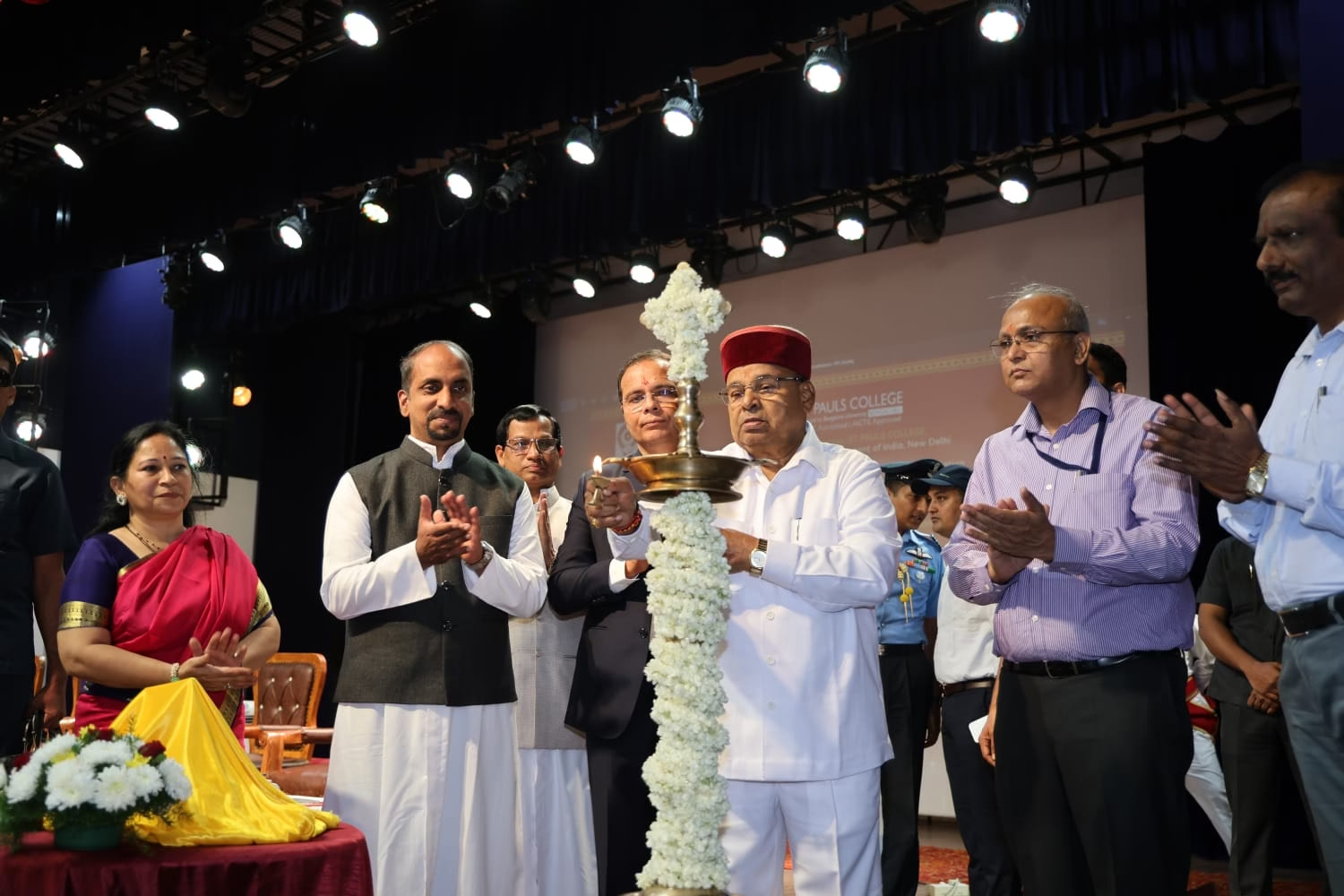
Thaawarchand Gehlot, Hon’ble Governor of Karnataka, inaugurated the two-day National Conference on “Importance of Indian Knowledge Systems in the Contemporary Context,” organized by the Department of Languages, St. Paul’s College under the auspices of the Central Directorate of Hindi, Ministry of Education, Government of India, and the Karnataka State University College Hindi Professors’ Association.
In his keynote address, Governor Gehlot highlighted the enduring relevance of the Indian knowledge tradition in today’s world, marked by stress, competition, technological advancement, and environmental challenges. “The Indian knowledge tradition shows us the path of restraint, balance, and coexistence amidst modern pressures,” he stated, emphasizing how India’s ethical and human values remain foundational in an era of artificial intelligence, globalization, and climate change.
Governor Gehlot traced the lineage of India’s civilizational wisdom, acknowledging contributions from ancient sages, saints, acharyas, and philosophers. “Indian civilization, one of the oldest globally, is a land of religion, culture, spirituality, and science. Its philosophy, developed over millennia, continues to guide humanity,” he remarked. Referencing foundational texts and sciences such as the Vedas, Upanishads, Ramayana, Mahabharata, Buddhist and Jain scriptures, Panini’s grammar, Charaka and Sushruta Samhita, Natya Shastra, Yoga, and meditation, he illustrated the breadth and depth of Indian thought.
The Governor also celebrated India’s pioneering scientific minds, including Aryabhata, Varahamihira, Charaka, Sushruta, Bhaskaracharya, and Nagarjuna, and noted the country’s historical leadership in mathematics, chemistry, medicine, astronomy, and environmental stewardship. “Ancient India was home to world-class centers of learning like Nalanda, Takshashila, and Vikramashila—drawing students from India and abroad,” he added.
Highlighting the importance of blending tradition and innovation, he said, “In the face of social, technological, and environmental challenges, the Indian tradition of knowledge provides solutions in balance, wisdom, coexistence, and sustainable development.” He stressed the global recognition of practices such as Yoga and Ayurveda, and their ongoing relevance for holistic health and well-being.
Governor Gehlot underscored India’s ancient environmental philosophy and the culture of reverence for nature, asserting that tolerance and integration are the hallmarks of the Indian knowledge heritage. “We have always expanded, shared, and adapted our knowledge, making Indian thought a driving force in nation-building and global progress today.”
He called upon everyone to embrace the values of compassion, truth, discipline, patriotism, and humanity alongside scientific and technological advancements. “A capable, sensitive, and prosperous India will emerge when modern innovation blends with Indian thinking and moral values. The new education policy aims to revitalize this tradition—a bold and historic effort,” he concluded.
The conference brought together distinguished dignitaries including Dr. Mohammed Naseem, Assistant Director, Central Hindi Directorate, New Delhi; Dr. Jayakar Shetty, Vice-Chancellor, Bangalore University; Father Dr. Thomas M.J., Principal, St. Paul’s College; Father Ronnie Lewis, Administrator; Dr. Tripti Sharma, President, Department of Languages, Karnataka State University Hindi Professors’ Association; and Dr. S.A. Manjunath, Founder President, St. Paul’s Society, among others. St. Paul’s College, noted for its value-based education and global professional standards, hosts this significant reflection on the enduring legacy and contemporary relevance of the Indian knowledge tradition.