









































Key Takeaways
- Nearly 95% of India’s trade by volume and about 70% by value moves through maritime routes, underlining the sector’s centrality to India’s economy and competitiveness.
- The Maritime India Vision 2030 charts 150+ initiatives with projected investments of ₹3–3.5 lakh crore, supported by a recent ₹69,725 crore package for shipbuilding.
- In FY 2024–25, major ports handled ~855 million tonnes of cargo, signaling robust growth in maritime trade and port efficiency.
Navigating India’s Maritime Path
Across the oceans runs the current of India’s economic strength. Nearly 95% of the country’s trade by volume and around 70% by value still traverses the nation’s maritime routes, highlighting the sea as the lifeblood of India’s commerce. From crude oil and coal to electronics, textiles, and agricultural products, the vast majority of imports and exports flow through bustling ports, connecting India to markets around the world. With globalisation deepening supply chain interdependence and India emerging as a major manufacturing and energy hub, the efficiency of ports and shipping directly influences national competitiveness.
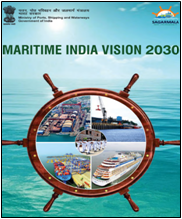
In a bold move to position itself as a global maritime powerhouse, India has set sail with the Maritime India Vision 2030 (MIV 2030), a transformative roadmap launched in 2021. With over 150 strategic initiatives, the vision seeks to modernise ports, expand shipping capacity, and strengthen inland waterways, while embedding sustainability and skill development at its core. More than a blueprint for cargo movement, MIV 2030 is a catalyst for trade, investment, and employment, charting India’s course toward economic growth and global competitiveness.
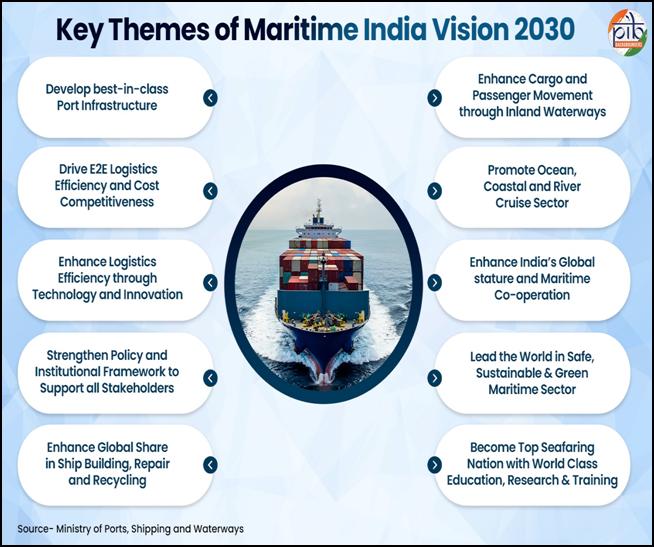
Central Themes of MIV 2030
The Maritime India Vision 2030 identifies ten pivotal themes that will shape India’s journey toward becoming a global maritime powerhouse, positioning the nation at the forefront of the international landscape.
| India Maritime Week 2025: The Maritime Ambition in Motion
India Maritime Week 2025 (IMW 2025) is a landmark event in the global maritime calendar, taking place from 27th to 31st October 2025 at the NESCO Exhibition Centre, Mumbai. Bringing together key stakeholders from the shipping, port, and logistics communities, IMW 2025 will serve as a strategic platform for dialogue, collaboration, and business development. The event is expecting participation from over 100 countries and drawing more than 100,000 delegates, port operators, investors, innovators, and policymakers alike. The five-day programme will feature 500 exhibitors, thematic pavilions, technology demonstrations, and sessions spanning port-led development, shipbuilding clusters, and digital corridors. |
Charting a Decade of Maritime Transformation: 2014 to 2025
Charting a new course for economic growth, India’s maritime sector is cruising ahead with record performance across ports, coastal shipping, and inland waterways. The sector’s progress underscores its critical role in strengthening the nation.
India’s Ports Set New Benchmarks
- India’s ports sector has witnessed a transformative leap, with total port capacity nearly doubling from 1,400 million metric tonnes per annum (MMTPA) to 2,762 MMTPA, reflecting major investments in modernisation and infrastructure.
- Cargo handling volumes have grown impressively from 972 Million Metric Tonnes (MMT) to 1,594 MMT, signaling robust growth in maritime trade and port efficiency with major ports handling approximately 855 million tonnes of cargo in FY 2024-2025, an increase from 819 million tonnes in FY 2023-24.
- Operational performance has improved significantly, as the average vessel turnaround time has been reduced from 93 hours to just 48 hours, enhancing overall productivity and global competitiveness.
- The sector’s financial strength has surged, with the net annual surplus rising sharply from ₹1,026 crore to ₹9,352 crore, underscoring improved revenue generation and cost management.
- Efficiency indicators have also strengthened, with the operating ratio improving from 73% to 43%, marking a major step toward sustainable and profitable port operations.
Indian Shipping Expands Fleet, Capacity, and Workforce
- India’s shipping sector has charted steady growth, with the number of Indian-flagged vessels rising from 1,205 to 1,549, reflecting the nation’s expanding maritime presence.
- The gross tonnage of the Indian fleet has increased from 10 million gross tonnes (MGT) to 13.52 MGT, underscoring a stronger and more capable shipping capacity.
- Coastal shipping has gained significant momentum, with cargo movement nearly doubling from 87 million metric tonnes (MMT) to 165 MMT, reinforcing the shift toward efficient, low-cost, and eco-friendly transport modes.
India’s Inland Waterways Surge Ahead
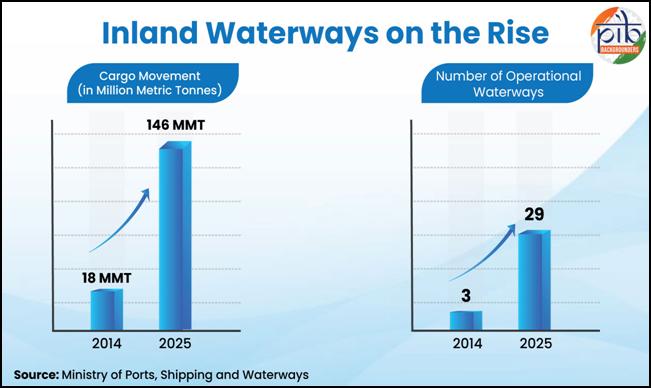
- In a landmark development for inland water transport sector, the Inland Waterways Authority of India (IWAI) reported a record cargo movement of 146 MMT in 2025, up from 18 MMT in 2014, an increase of around 710 percent.
- The number of operational waterways has increased remarkably from 3 to 29, reflecting a major boost to India’s inland transport network.
- IWAI handed over the Haldia Multi-Modal Terminal (MMT) to IRC Natural Resources, marking a major step in advancing inland waterway infrastructure and promoting multimodal logistics under the Public Private Partnership (PPP) model. Built with World Bank’s assistance, the West Bengal terminal has a capacity of 3.08 million metric tonnes per annum (MMTPA).
- Ferry and Ro-Pax (a ship that carries both vehicles and passengers) have also gained strong traction, carrying over 7.5 crore passengers in 2024–25, reflecting growing public adoption of water-based transport for safe and efficient travel.
| In just a decade, India’s seafarer workforce has surged from 1.25 lakh to over 3 lakh, now accounting for 12% of the global seafaring workforce, making the country one of the world’s top three suppliers of trained seafarers and opening up vast opportunities in navigation, ship operations, logistics, and allied maritime industries at home and overseas. |
Financing the Waves: Support & Innovation
The MIV 2030 projects a total investment of INR 3–3.5 lakh crore across ports, shipping, and inland waterways. Backed by a recent landmark package of ₹69,725 crore to boost shipbuilding and revitalise the maritime ecosystem, India is charting a strategic course to leverage its vast coastline to anchor itself firmly on the global maritime map. The targeted allocations and strategic initiatives align seamlessly with the overall vision, translating its projected investments into actionable measures.
| With a ₹25,000 crore corpus, the Maritime Development Fund (MDF) is set to provide long-term financing to expand India’s shipping tonnage and shipbuilding capacity. Complementing this, the revamped Shipbuilding Financial Assistance Scheme (SBFAS) with an outlay of ₹24,736 crore, tackles domestic cost disadvantages and incentivises ship-breaking, while the Shipbuilding Development Scheme (SbDS) drives greenfield clusters, yard expansions, and risk coverage with ₹19,989 crores outlay. Adding to this, the ₹305 crore Indian Ship Technology Centre (ISTC) in Visakhapatnam will emerge as a national hub for ship design, R&D, engineering, and skill development. |
| Over ₹1,000 crore has been invested in the development of Inland Waterway Infrastructure across Northeast India, marking a significant push to enhance transportation and trade through the country’s river networks. Of this investment, projects valued at around ₹300 crore have already been completed, and the remainder approaching completion, providing a boost to connectivity and regional commerce. The region is also set for a major tourism upgrade, with two luxury cruise ships currently being built at the Hooghly Cochin Shipyard in Howrah, Kolkata, at a combined investment of ₹250 crore. Slated for launch in 2027, the vessels will ply the Brahmaputra River, promising to transform Assam’s river tourism landscape under the government’s Cruise Bharat Mission. |
Sagarmala Programme, a flagship initiative to transform India into a global maritime hub is a core pillar of the Maritime India Vision 2030 and Maritime Amrit Kaal Vision 2047. The programme focuses on cutting logistics costs, enhancing trade efficiency, and creating employment through smarter, greener transport networks. Under its sphere, 840 projects worth ₹5.8 lakh crore are being implemented by 2035, with 272 projects worth ₹1.41 lakh crore completed and 217 projects worth ₹1.65 lakh crore in progress. |
Sailing into the Future
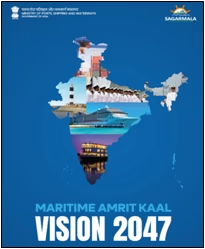
India’s maritime sector is entering a decisive decade, with new laws, mega projects, and global investment ambitions shaping the Maritime India Vision 2030. With a strong focus on green technologies and digital innovation, India is preparing to not only meet its trade demands but also emerge as a maritime leader. Building onto this foundation is the Maritime Amrit Kaal Vision 2047, a long-term roadmap for India’s maritime resurgence, with investments of nearly ₹80 lakh crore earmarked for ports, coastal shipping, inland waterways, shipbuilding, and green shipping initiatives. The government is driving sustainable maritime operations by setting up green corridors, introducing green hydrogen bunkering at major ports, and promoting the use of methanol-fueled vessels. Outlining more than 300 actionable initiatives it projects India’s rise as one of the world’s top maritime and shipbuilding powers by the centenary of independence.
The momentum of this vision has been carried forward through landmark initiatives that are reshaping India’s maritime landscape. A historic milestone in this journey was achieved in September 2025 during the “Samudra Se Samriddhi – Transforming India’s Maritime Sector” event where 27 Memoranda of Understanding (MoUs) were exchanged, unlocking investment potential of over ₹66,000 crore and paving the way for more than 1.5 lakh jobs. The agreements spanned port infrastructure, shipping, shipbuilding, sustainable mobility, finance, and heritage, reflecting India’s integrated vision for becoming a global maritime and shipbuilding hub.
Notable projects included Greenfield Port at Bahuda in Odisha with 150 million tonnes per annum (MTPA) capacity at an expected investment of around ₹21,500 crore, Water Metro Project in Patna using electric ferries valued at around ₹908 crore, and a strategic Vessel Owning Joint Venture Company between Shipping Corporation of India (SCI) and Oil Public Sector Undertakings (PSUs) to reduce foreign fleet dependence and boost Indian-built ships. Alongside this, shipbuilding MoUs across five states, major shipyard investments, financing tie-ups, and a ₹266 crore lighthouse museum at the National Maritime Heritage Complex in Lothal, Gujarat further reinforce India’s vision to rank among the world’s top shipbuilding nations by 2047.
Under the New Mangalore Port Authority (NMPA), eight significant maritime development projects have been launched recently, including construction of a dedicated cruise gate for international tourists, establishment of a 150-bed multi-speciality hospital under PPP mode with an investment of ₹107 crore, among others to enhance user experience and operational capacity. These developments exemplify the commitment to creating a future-ready maritime ecosystem that fosters trade, tourism, and economic resilience.
From Vision to Voyage
India is turning its vast coastline into a canvas of possibilities. With Maritime India Vision 2030, the nation is not just building ports, it’s building futures, empowering millions with jobs, skills, and sustainable growth. This is India’s moment to rise as a global maritime leader, proving that vision, strategy, and determination can turn waves into pathways of prosperity. In shipping lanes that carry the world’s oil and cargo, India is determined to secure its place not as a passenger, but as a navigator of the future. The Maritime Amrit Kaal Vision 2047 extends this journey further. From green ports and sustainable shipping to smart logistics and cultural heritage projects, India is aligning economic growth with environmental responsibility and global leadership. As the world looks to resilient supply chains and clean energy transitions, India’s maritime sector is poised not just to serve national interests, but to shape the very currents of global trade in the decades to come.