



























Bengaluru, November 29, 2025.
“The two-day international conference on ‘Language, Culture and World Peace – Dialogue for a Peaceful World,’ organized by the Center for Global Languages in collaboration with IQAC and the Faculty of Arts, Dr. Manmohan Singh Bengaluru City University, witnessed a profound discussion on technology, language, peace, and cultural preservation.
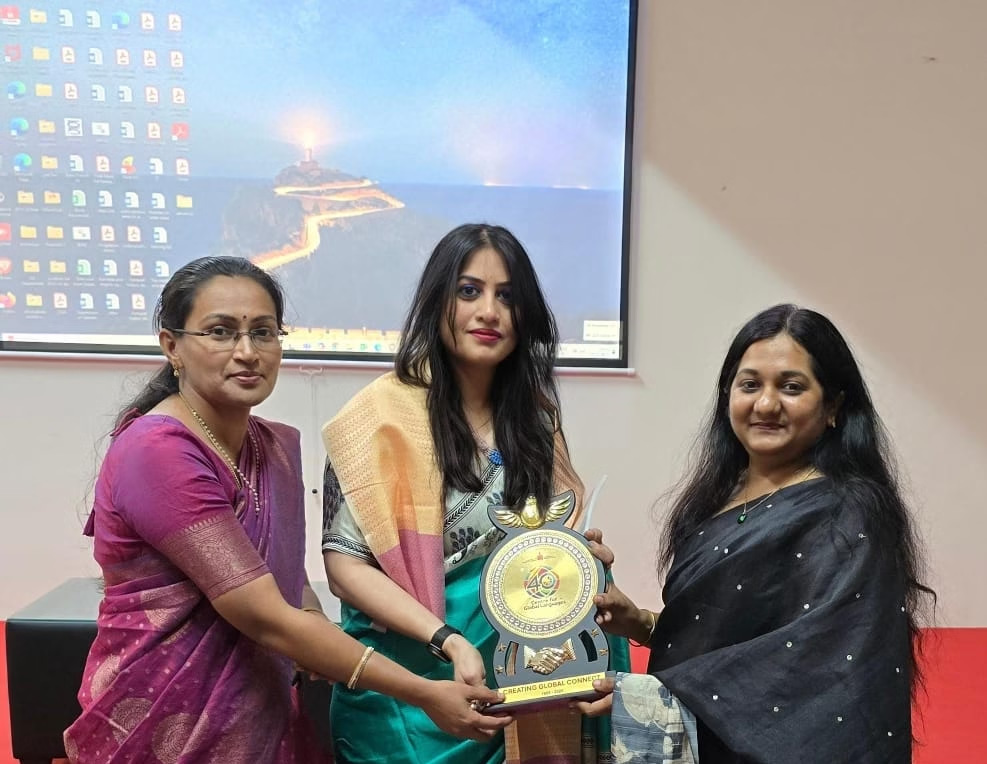
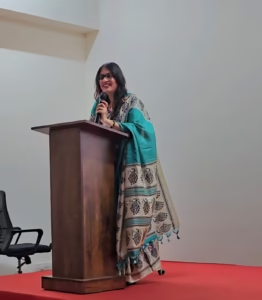
Addressing the session as the keynote speaker, senior journalist, space science-tech, Dr. Anubha Jain said, “Today, technology is not only transforming economies but also preserving cultures and bringing diverse communities closer. Tools like digital archives, virtual reality museums, and social media have become powerful bridges between the past and the future.” On the occasion, Dr. Anubha Jain was welcomed by Dr. Jyothi Venkatesh, Dean, Faculty of Arts, Dr. Manmohan Singh Bengaluru City University, and Director of the Centre for Global Languages, and Jain was honored with a citation and a shawl.
The conference was inaugurated in the presence of eminent academician Prof. Fady Fadel (France), Chief Guest Jigme Tsultrim (Central Tibetan Administration), and literary figure Prof. Rajendra Chenni. Guests of Honor included Jean-Marc Depierre, Director of Alliance Française de Bengaluru, and Dr. Michael Heinst, Director of Goethe-Institut/Max Müeller Bhavan, giving the event an international dimension. In his presidential address, Prof. Ramesh B., Vice-Chancellor of the University, described language and culture as the foundation of world peace. During the two-day conference, 97 research papers were presented in ten parallel technical sessions. These sessions, held in six languages—English, Kannada, French, German, Spanish, and Tibetan—covered topics such as multilingual education, cultural preservation, literary translation, post-colonial studies, and AI ethics. Discussions focused on topics such as: A special highlight of the conference was a workshop on “Conversational Language Modeling with Generative AI” conducted by Dr. Arunkumar Santhalingam. Dr. (Col.) K.M. Harikrishnan’s lecture on trauma-sensitive communication, Dr. Anubha Jain’s lecture on media technology and cultural preservation & exchange, and Prof. Francis Rousseau’s address on AI and ethics were also highly discussed.
In her address, Dr. Anubha Jain noted that technology, if not used carefully, can distort culture—“Biases in data can lead AI to misinterpret traditions, and deepfakes can even alter history. Therefore, tomorrow requires not just technology, but also conscience.” Citing a UNESCO report, he explained that over 1,200 World Heritage sites and 300,000 cultural objects have been digitally preserved. India’s National Mission on Manuscripts has digitized over five million rare manuscripts. The Google Arts & Culture platform has made over 2,000 museums available online, making the world accessible at just one click, from the Eiffel Tower to the Ajanta Caves. Dr. Jain concluded by saying, “Creativity, knowledge, and sensitivity must be applied to language preservation, cultural dialogue, and the purposeful use of technology—this will secure humanity’s future.”
The session on Tibetan Studies, by the Dalai Lama Institute of Higher Education, added new depth to the discussion on language, culture, and identity. This international conference concluded successfully, providing a strong foundation for understanding, dialogue, and world peace among diverse languages and cultures.