











































PhysicsWallah fined ₹5 lakh and McAfee ₹1 lakh for practices affecting informed consumer choice
Companies directed to discontinue practices that undermine informed consumer consent
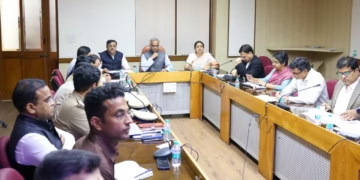
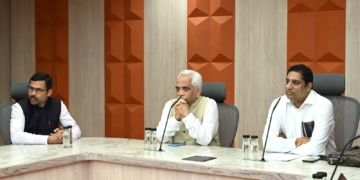
The Central Consumer Protection Authority (CCPA), headed by Chief Commissioner Smt. Nidhi Khare and Commissioner Anupam Mishra, has imposed penalties on PhysicsWallah Limited and McAfee Software India Private Limited for using dark pattern practices that misled consumers and influenced their choices on digital platforms.
PhysicsWallah has been fined ₹5 lakh, while McAfee has been fined ₹1 lakh. Both companies have been directed to remove such practices from their platforms and ensure that consumers are able to make informed choices without pressure or manipulation.
The action has been taken under the Consumer Protection Act, 2019, the Consumer Protection (E-Commerce) Rules, 2020, and the Guidelines for Prevention and Regulation of Dark Patterns, 2023.
PhysicsWallah Limited: Pre-selected Donations and Misleading ‘Free’ Courses
CCPA took suo motu cognizance of certain practices on the PhysicsWallah platform and found that consumers were being influenced through interface designs that affected their ability to make free and informed choices.
What CCPA Found
- A donation of ₹10 to the PW Foundation was automatically selected during checkout and added to the total payable amount without the consumer’s explicit consent.
- Consumers were shown emotional messages related to children’s education, healthcare and marriages, encouraging them to keep the donation selected.
- Courses advertised as “free” could only be accessed after users shared personal information such as their mobile number and email address.
- CCPA’s examination found that the content offered remained the same across user accounts, indicating that mandatory data collection was not essential for accessing the courses.
Dark Patterns Identified
- Basket Sneaking – Automatic addition of a donation during checkout.
- Confirm Shaming – Emotional messaging that discouraged users from removing the donation.
- Forced Action – Requiring users to share personal information before accessing courses advertised as free.
CCPA observed that:
- Consumer consent cannot be assumed through pre-selected options and must always be obtained through a clear and affirmative action.
- Advertising courses as “free” without clearly informing users about mandatory registration and data-sharing requirements was misleading.
- The practices amounted to unfair trade practices and interfered with consumers’ ability to make informed decisions.
- Since a large number of users on the platform are students, including minors, such practices raised serious consumer protection concerns.
Provisions Violated –PhysicsWallah
| S.No. | Provision | Nature of Violation |
|
|
Section 2(9), Consumer Protection Act, 2019 | Violation of consumer rights-impairment of free and informed decision-making |
|
|
Section 2(28), Consumer Protection Act, 2019 | Misleading advertisement- ‘free courses’ without disclosing mandatory registration conditions |
|
|
Section 2(47), Consumer Protection Act, 2019 | Unfair trade practice- basket sneaking, confirm shaming, forced action |
|
|
Consumer Protection (E-Commerce) Rules, 2020 | Rule 4(9): Automatic recording of consent through pre-ticked checkbox; Rule 4(3): Unfair trade practice |
|
|
Dark Patterns Guidelines, 2023 | Basket Sneaking, Confirm Shaming, Forced Action |
PhysicsWallah Limited has been directed to ensure that no dark patterns are deployed on any of its digital interfaces and pay a penalty of ₹5,00,000.
McAfee Software India Private Limited: Subscription Renewal Interface Found Misleading
CCPA also examined McAfee’s subscription renewal process and found that consumers were not provided with a neutral choice while deciding whether to renew their subscriptions.
Users were prominently shown two options – “Renew Now” and “Accept Risk” effectively portraying non-renewal as a risky decision.
What CCPA Found
- The phrase “Accept Risk” suggested that consumers would be exposed to cybersecurity threats if they chose not to renew their subscription.
- Such a claim could not be justified or guaranteed by the company.
- The design of the interface created pressure on consumers to continue their subscriptions.
Dark Patterns Identified
- Confirm Shaming – Making consumers feel irresponsible for not renewing.
- Interface Interference – Giving greater visual prominence to the renewal option.
- Trick Question – Using confusing and emotionally loaded language instead of a neutral option.
- Forced Action – Not providing a clearly visible and neutral opt-out choice.
CCPA’s Observations
CCPA noted that consumers should be able to make subscription decisions freely and without fear-based messaging or misleading design elements.The Authority found that the renewal interface used deceptive practices that could influence consumer decisions and amount to unfair trade practices.
Provisions Violated- McAfee
| S.No. | Provision | Nature of Violation |
|
|
Section 2(28), Consumer Protection Act, 2019 | Misleading advertisement: fear-based representation regarding necessity and consequences of non-renewal |
|
|
Section 2(47), Consumer Protection Act, 2019 | Unfair trade practice: deceptive and manipulative interface design promoting subscription renewals |
|
|
Consumer Protection (E-Commerce) Rules, 2020 | Rule 4(3): Unfair trade practice & Rule 4(9): Impaired explicit and affirmative consumer consent |
|
|
Dark Patterns Guidelines, 2023 | Confirm Shaming, Interface Interference, Trick Question, Forced Action |
McAfee Software India Private Limited has been directed to ensure that no dark patterns are employed on its platform, website, application or any other digital interface and pay a penalty of ₹1,00,000.
CCPA’s Continued Action Against Dark Patterns
The Guidelines for Prevention and Regulation of Dark Patterns, 2023, were notified by CCPA on 30 November 2023 after extensive consultations with stakeholders.The Guidelines identify 13 dark patterns that are considered unfair trade practices, including Basket Sneaking, Confirm Shaming, Forced Action, Interface Interference and Trick Questions.
To strengthen compliance, CCPA issued an advisory on 5 June 2025 asking e-commerce companies and digital platforms to conduct self-audits and remove dark patterns from their interfaces.These orders underline CCPA’s commitment to ensuring a fair, transparent and consumer-friendly digital marketplace. The Authority has reiterated that consumer consent must always be explicit, informed and free from manipulative design practices.
Final Orders may be accessed at: https://jagograhakjago.gov.in/CCPA_Orders/index.html
SOURCE-PRESS INFORMATION BUREAU-PIB,NEW DELHI.