





![[ L to R ]Mr. Rohan Ganapathy, Co-Chairman, CII National Committee on Space; Mr. Mallavarapu Apparao, Chairman, CII National Committee on Space; Ms. Jaya Choraria, Deputy Trade Commissioner for South Asia, UK; H.E. Mr. Antonio Bartoli, Ambassador of Italy to India; Dr. Pawan Goenka, Chairman, IN-SPACe; Dr V. Narayanan, Secretary, Department of Space; Chairman, Space Commission; and Chairman, ISRO; Mr. Shashwat Goenka, Vice President, CII; H.E. Mr. Philip Green OAM, High Commissioner of Australia to India; Mr. ISHII Yasuo, Senior Vice President, JAXA; Mr. Radha Krishnan A, Chairman and Managing Director, NSIL](https://24x7newsworld.com/wp-content/uploads/2026/09/Screenshot-2026-09-08-at-20-52-52-DSC_6125.JPG-JPEG-Image-6048-×-4024-pixels-—-Scaled-14_-360x180.avif)











Bengaluru, July 01 (Karnataka News):
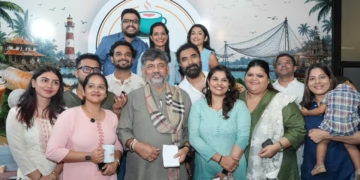
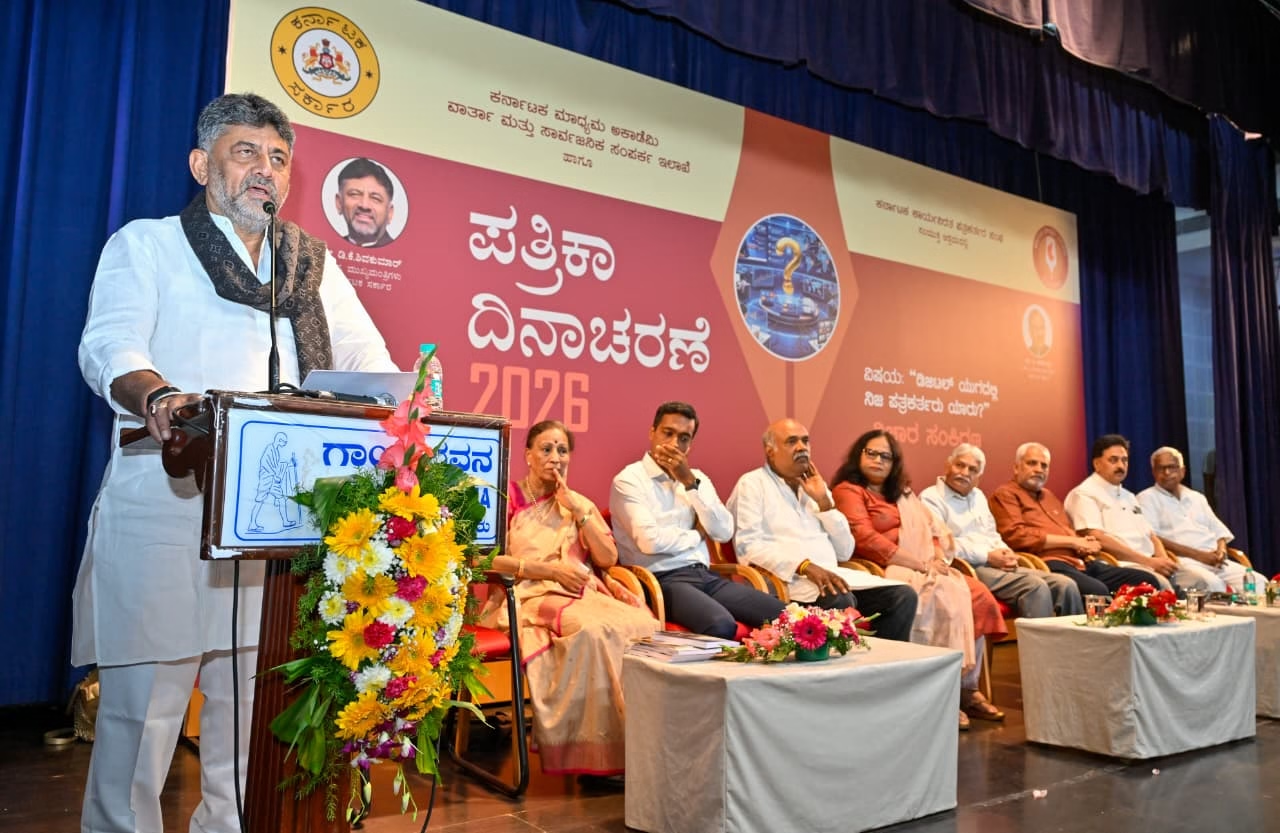
Chief Minister D.K. Shivakumar advised media representatives at the Press Day celebration program to work according to their conscience while writing and conveying ideas to the society, regardless of personal feelings.
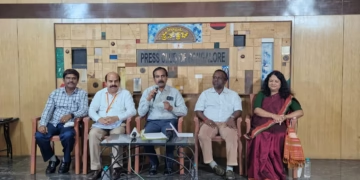
Speaking after inaugurating the Press Day program organized by the Karnataka Media Academy and the Karnataka Working Journalists Association at Gandhi Bhavan, he said that the press is the fourth pillar of democracy like the legislature, executive and judiciary. No matter what mistake someone makes, it is only the press that has the great opportunity and power to criticize it, change the society and correct the mistakes. However, he expressed deep sadness over the recent increase in fake news in the media.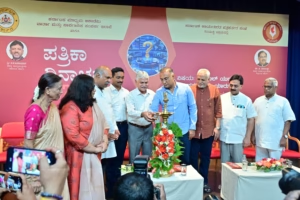
This morning I went to the hospital for a routine check-up. But they said that they are spreading false news on TV channels that I have been admitted to the hospital. The tendency to post one message per minute without checking the veracity of the news, just in the rush of TRP or competition, is not right. This hurts the dignity of others. Therefore, writing the truth, speaking the truth and respecting the truth should be the first duty of journalism, he told the media.
It is natural for a human to make mistakes, if I also make a mistake, let me know. But do not publish and circulate false news. Until the news is published, it belongs to the journalists. After it is published, it becomes the property of the society. Therefore, there should be truth and honesty in every news, the Chief Minister said in his ear.
Many great personalities, including Mahatma Gandhi, have elevated the prestige of journalism as journalists. He called upon journalists to continue that legacy and work towards maintaining public respect for the media.
MLA and former minister Dinesh R Gundu Rao, who presided over the program, said that the impact of digitalization in the media sector has given a greater speed to the exchange of information. However, in the current days, analyzing what is real news and what is fake news has become a big challenge. The public is losing patience to read the entire news report and is increasingly inclined to interpret it only by looking at the headlines and react immediately. He expressed concern that this is having a direct impact on the objectivity and quality of journalism.
He said that in recent times, media organizations are falling into the hands of big businessmen and the corporate sector, which is why transparency is disappearing in journalism. He opined that an environment needs to be created where journalists can work independently without any fear or intimidation.
During the country’s freedom struggle, great figures like Mahatma Gandhi, Jawaharlal Nehru, Lokmanya Tilak and Dr. B.R. Ambedkar created public awareness through journalism. Today’s media also needs to follow the same path. He praised the Karnataka Patrika Academy for providing all kinds of encouragement and cooperation required for the protection of the interests of journalists, development of professional skills and improvement of the media sector.
Speaking on the topic “Who are the real journalists in the digital age?”, senior journalist Abussalam Puttige said that those who innovate and embrace innovation rule the world. “Today’s digital age is not an enemy to print media, but rather a boon,” he opined.
Earlier, two hands were required to read a newspaper. But today, with the help of technology, the same newspaper can be read with just one hand, through mobile screens. Newspapers that used to reach one lakh people with just one lakh printed copies, today reach crores of people thanks to new technology. Therefore, he clarified that the print media are not victims of the digital age, but its beneficiaries.
In the past, when radio came, it was thought that the print media was over. Then, when TV came, it was also analyzed that the life of journalism was over. But today, TV itself seems to be reaching its end, and the era of radio has also faded. But the printed newspaper is the only one that has remained very powerful and alive to this day. Even in a country like Japan, which is at the forefront of technology, there is still a considerable demand for printed newspapers.
He said that even if the tools or technologies change, the values and commitments of a journalist towards society do not change. Be it the print era, the digital era or the upcoming AI era; the main duty of journalists is to provide reliable information, spread good news and keep the society informed.
Telangana Media Academy President K. Srinivas Reddy said that although Karnataka and Telangana are separated by borders, they are united by the problems and challenges faced by media institutions. Regional academies should give priority to local issues. He hoped that we too need to celebrate Telugu Media Day just as Karnataka Media Day is celebrated.
The digital age has brought about an information revolution in the media sector. But it has also created a crisis. At a time when most media outlets have compromised, we are fighting against big corporations that make money through fraud. In this hostile environment, we need to ask the question of who is a real journalist. Those who want to directly and institutionally oppose the governance of the digital world can be redefined as real journalists. He suggested that the media, which is giving importance to exciting news, should give more importance to the truth.
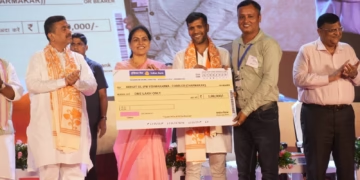
On this occasion, the annual report of the Media Academy and the book ‘Indian Journalism’ were released. Certificates were given to media representatives who conducted research on various issues in the field of journalism and submitted reports to the Media Academy. Similarly, a media kit including a laptop and a camera was distributed by the Department of Information and Public Relations to media representatives from backward classes.
The program was attended by Karnataka Media Academy President Ayesha Khanam, Kannada Development Authority President Dr. Puruṣṭittam Bilimane, Information and Public Relations Department Commissioner M.N. Anucheth, Gandhi Memorial Fund President Wooday P. Krishna, Karnataka Working Journalists Association State President Shivananda Tagadoor, Karnataka Women Journalists Association President Dr. R. Purnima, Media Academy Secretary Sahana. M, Karnataka Working Journalists Association General Secretary G.C. Lokesh, Information and Public Relations Department Joint Director Manjunath Dollin, Deputy Director Gurunath Kadaboora and other senior journalists.