
































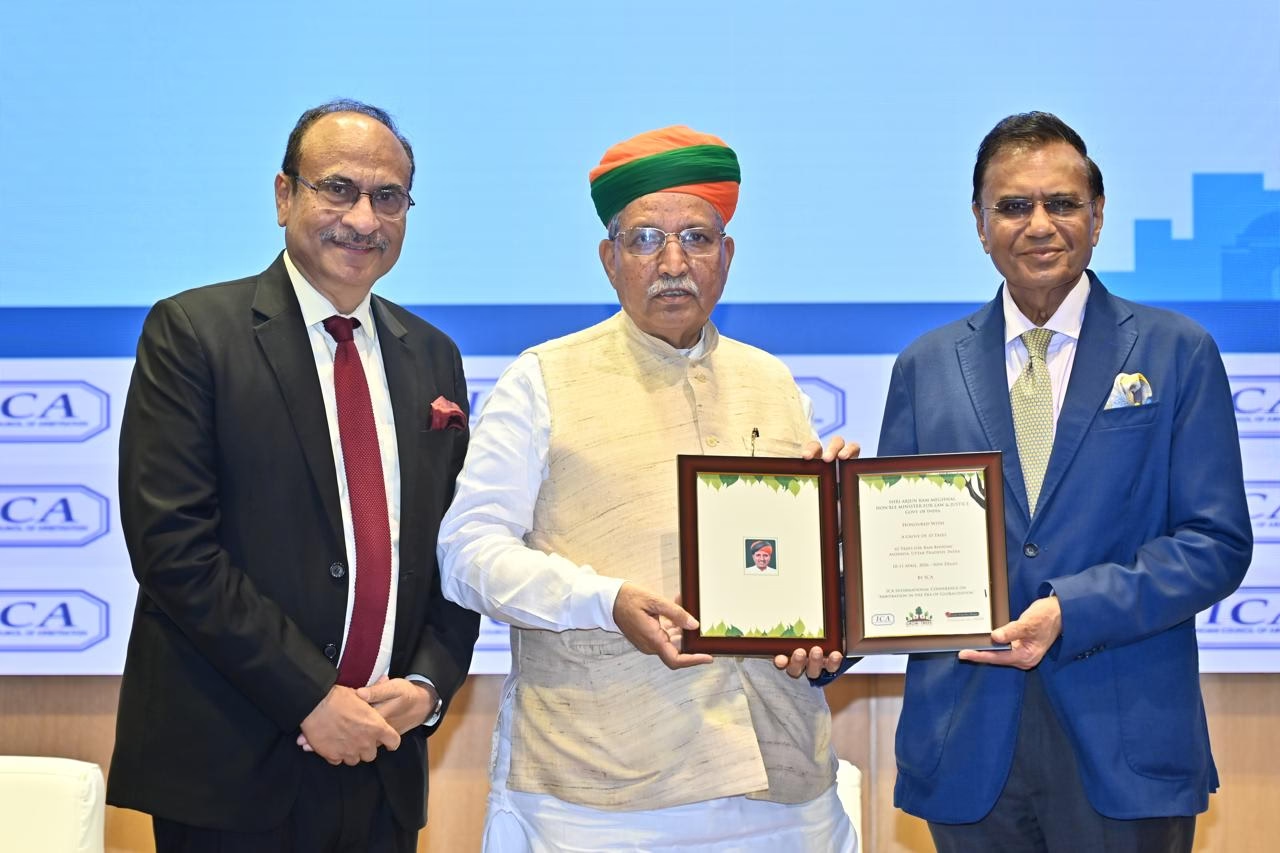
New Delhi, April 11, 2026: Union Law and Justice Minister Arjun Ram Meghwal on Saturday highlighted the Government’s focus on strengthening institutional arbitration, decriminalising minor offences, and modernising legacy laws to align with constitutional values and ease of doing business.
Addressing the valedictory session on the concluding day of International Conference on “Arbitration in the Era of Globalisation” organised by the Indian Council of Arbitration (ICA) in the national capital, the Minister stressed the growing importance of structured dispute resolution systems in a rapidly evolving global economy.
Emphasising a shift in approach, Meghwal said, “Instead of ad-hoc arbitration, there should be institutional arbitration. We agree with this approach, and when we agree, you can be assured that the Government will work decisively in this direction, strengthening dispute resolution mechanisms and building greater trust in the system.”
He noted that reforms relating to arbitration frameworks, including provisions concerning appointment of arbitrators and commercial law processes, are under active consideration, with committees already examining key aspects.
Highlighting the Government’s reform agenda, the Minister said that nearly “1000 offences have been decriminalised,” describing it as a major step towards improving regulatory efficiency. “Nearly 1000 offences have been decriminalised. There were situations where a fine of 100 rupees required a process costing 10,000 rupees. Such provisions needed rationalisation, and our effort is to make laws practical, efficient, and supportive of ease of doing business,” he said.
Meghwal also referred to efforts to remove outdated and discriminatory provisions from colonial-era laws, including changes to the Indian Succession Act, 1925. “Some provisions in older laws were discriminatory and did not reflect the principle of equality. Our Constitution stands on equality, liberty, fraternity, and justice, and it is our responsibility to ensure that every law aligns with these foundational values,” he said.
The Minister also drew attention to broader systemic reforms, including significant changes in the criminal justice framework, and underlined their importance alongside civil and commercial law reforms.
Referring to legislative developments, he said that a Public Trust Bill has been passed during the ongoing Budget Session after detailed scrutiny by a Joint Parliamentary Committee.
He also highlighted the increasing role of technology in the legal sector, including artificial intelligence and virtual hearings, as key enablers of efficient dispute resolution.
Drawing from India’s traditional systems, Meghwal referred to the concept of “Panch Parmeshwar,” noting its emphasis on neutrality, impartiality, and binding decisions, and its relevance to modern arbitration practices.
The Minister further informed that India will host a BRICS conference in Ahmedabad, bringing together justice ministers and officials from ten countries to strengthen international legal cooperation.
He reiterated that ongoing legal and institutional reforms are integral to India’s broader economic vision and its journey towards becoming one of the world’s leading economies.