























NHRC Chairperson, Justice V. Ramasubramanian says, civil servants should ensure delivery of the benefits of welfare schemes reach the common man
Dr. P.K. Mishra, Principal Secretary to PM contrasts the pre-2014 legal-centric rights approach with the post-2014 saturation model, centred on closing last-mile gaps
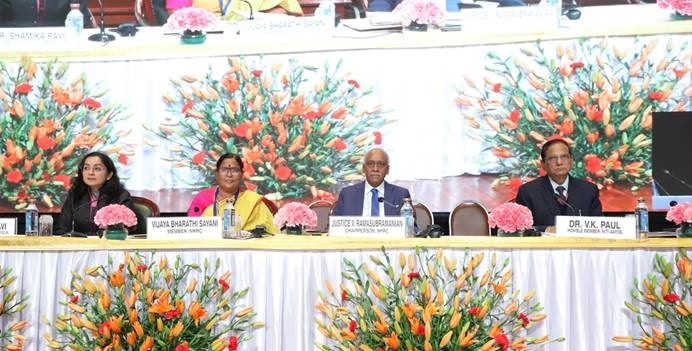
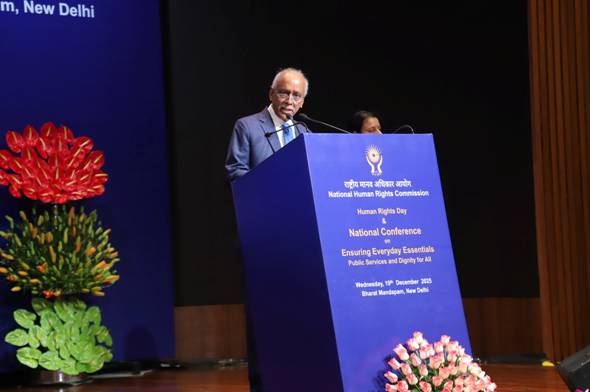
The National Human Rights Commission (NHRC), India organised a National Conference on ‘Ensuring Everyday Essentials: Public Services and Dignity for All’ to commemorate Human Rights Day at Bharat Mandapam, New Delhi today. Chairing the inaugural session, NHRC, India Chairperson, Justice V. Ramasubramanian said that the Commission has looked at the theme of this year’s Human Rights Day from the perspective of public services in India and the dignity of the citizens. The reason why we chose public services and dignity of the individual as ‘everyday essentials’ is that our country is a welfare State, as seen from the Directive Principles of State Policy.
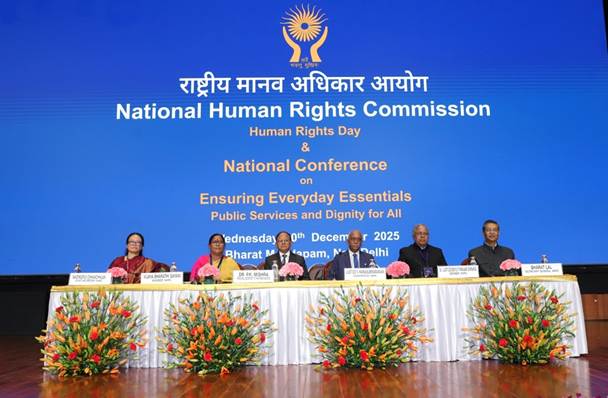
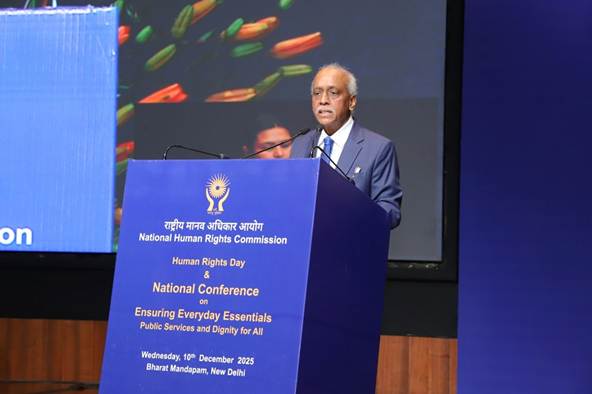
He said that while policies are framed by elected representatives for the welfare of the people, they are implemented through officers who are in the civil services of the Union or the State and called public servants. Therefore, enabling and assisting an elected Government to frame policies for the welfare of the people and ensuring that the benefits of those policies reach the common man is the task assigned to public servants. Quoting the Ramayana, he highlighted three ideals for launching an undertaking which has maximum benefit with minimum cost and without delay.
Delivering the keynote address, Dr. P. K. Mishra, Principal Secretary to the Prime Minister reflected on Human Rights Day as a reaffirmation of India’s democratic values. Citing Article 25 of the Universal Declaration of Human Rights, he highlighted India’s remarkable progress in the past decade in improving standards of living through housing, nutrition, clothing, medical care and livelihood security. He recalled Hansa Mehta’s contribution in ensuring gender-sensitive language in the UDHR and noted India’s evolution from civil and political rights to socio-economic, ecological and cultural rights shaped by digital transformation and environmental consciousness.
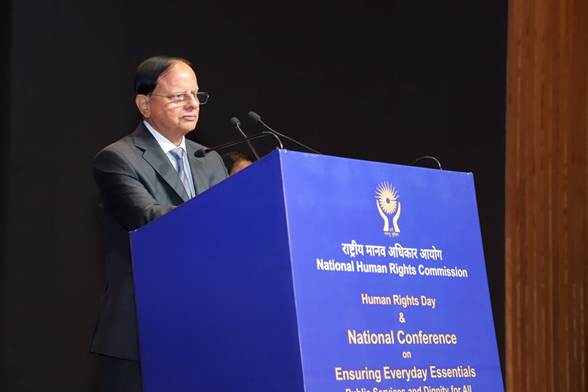
Dr. Mishra contrasted the pre-2014 legal-centric rights approach with the post-2014 saturation model, centred on closing last-mile gaps so that every entitlement reaches every citizen. He detailed major achievements, including 4 crore pucca houses under PMAY, 12 crore tap-water connections under JJM, Swachh Bharat sanitation coverage, Saubhagya electrification, Ujjwala clean cooking gas, free food grains for 80 crore people, Ayushman Bharat benefiting 42 crore citizens and expanded social security and reforms for gig and platform workers. He highlighted rapid declines in multidimensional poverty, the success of Aspirational Districts, the COVID-19 response and the ongoing Viksit Bharat Sankalp Yatra.
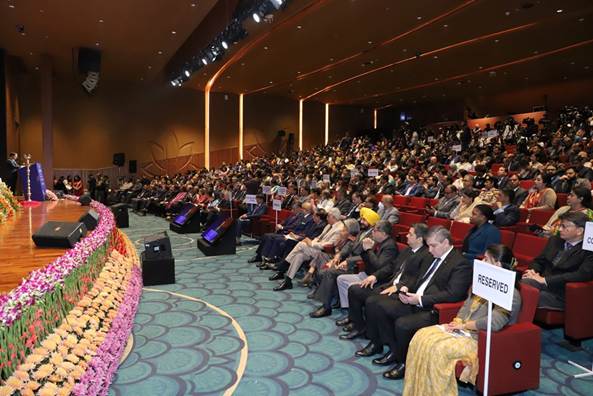
Calling upon NHRC to examine emerging challenges, climate and environmental rights, AI and technology governance, gig-economy protections and digital surveillance, he said that good governance is itself a human right, rooted in empathy and dignity.
Before this, NHRC, India Secretary General, Shri Bharat Lal in his address said that the Commission continues to work to ensure equitable access to essential services through a wide spectrum of interventions. This year’s Human Rights Day theme highlights human dignity is shaped by people’s experience about access to basic amenities and essential public services every day. These are not administrative conveniences but fundamental entitlements. He gave a brief insight into the two thematic sessions of the Conference including ‘Basic Amenities for All: A Human Rights Approach and ‘Ensuring Public Services and Dignity for All.’
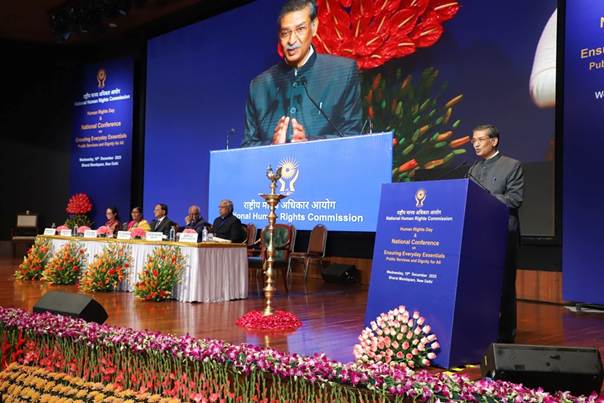
NHRC, India Chairperson, Justice V. Ramasubramanian chaired the first session on ‘Basic Amenities for All: A Human Rights Approach. Speaking as a panellist, NHRC Member, Smt Vijaya Bharathi Sayani said that there must be clear standards of service delivery, monitoring and grievance redressal. She emphasised zero tolerance for corruption and negligence to ensure that services reach the person who need them the most. She said that the NHRC has been addressing a wide range of human rights concerns in different aspects of life including education, health, shelter homes, elderly care among others.
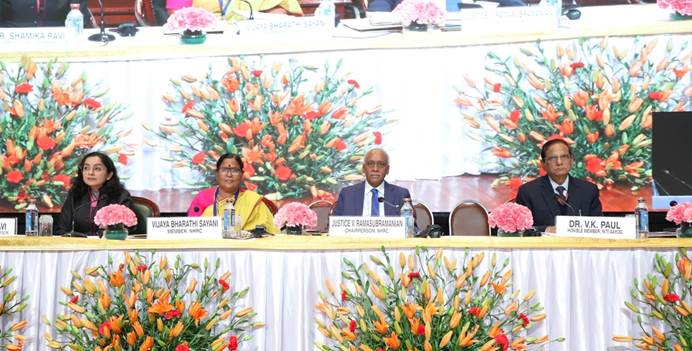
Dr. V.K. Paul, Member, NITI Aayog, speaking as a panellist, highlighted the WHO definition of health as complete physical, mental and social well-being, noting that while the Constitution does not explicitly guarantee the Right to Health, courts have read it into Article 21. He drew attention to persisting inequities, with poorer communities facing higher disease burdens. He said that health is shaped by biological, social, environmental and commercial determinants like tobacco and unhealthy food marketing.
He showcased India’s progress through Swachh Bharat Mission, which enabled construction of over 12 crore toilets and Jal Jeevan Mission, expanding rural tap water access from 17% to 83% in five years. Universal Health Coverage has advanced through Ayushman Bharat–PM-JAY, now covering nearly 600 million people and over 70,000 daily admissions, reducing out-of-pocket expenditure to about 39%. Over 1.77 lakh Ayushman Arogya Mandirs now deliver expanded services, including Non-Communicable Diseases (NCDs) and mental health. Dr. Paul highlighted the strengthened primary healthcare, NCD control and a new National Mental Health Programme.
Dr. Shamika Ravi, Member, EAC- PM spoke about several areas where improved access has strengthened everyday dignity. She said that India now produces enough food for all. She said that the challenge is nutrition rather than scarcity. Dietary patterns among the poorest households show an encouraging shift toward more diverse and healthier foods. The building of over 120 million toilets has not only boosted public health but significantly improved women’s safety. Dr. Ravi noted that 302 million people have moved out of moderate poverty in the last decade, with progress seen across all major social groups.
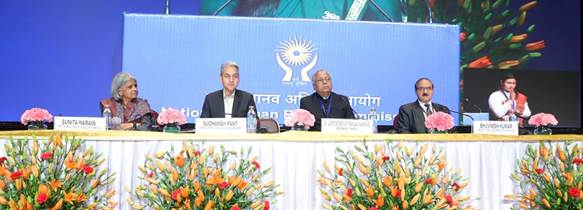
Chairing the second session on ‘Ensuring Public Services and Dignity for All’ NHRC, India Member, Justice (Dr) Bidyut Ranjan Sarangi said that food, clothes and housing meet basic needs, but true nation-building requires going beyond minimum entitlements to ensure dignity, empowerment and meaningful well-being for every individual. He highlighted the need for introspection and collective action to build a stronger and more humane Bharat.
Shri Sudhansh Pant, Secretary Ministry of Social Justice and Empowerment highlighted the skill development opportunities with scholarship and financial support to various segments of students to ensure their right to dignity through education and enterprise. He cited impactful initiatives such as Swachhata Udhyami Yojana, assistive devices for senior citizens and dignified digital access via Aadhaar-enabled public service delivery. He emphasised that dignity is strengthened when grievance redressal, banking, ticketing and essential services are available at one’s fingertips.
Shri Bhuvnesh Kumar, Chief Executive Officer, UIDAI highlighted the utility of Aadhaar for authentication to get various services. He clarified common misconceptions, noting that Aadhaar is a unique identification number- not proof of citizenship, domicile or date of birth. With 1.42 billion Aadhaar numbers issued and billions of authentications conducted, Aadhaar has significantly reduced identity fraud and strengthened delivery of benefits through the JAM Trinity- Jan Dhan, Aadhaar and Mobile.
Ms. Sunita Narain, Director General, Centre for Science and Environment emphasised the importance of right to a clean environment in realising a dignified life. Noting the progress, she called for more innovative, scalable and institutionally supported solutions in the field of sanitation, energy and public health. She urged strengthening public institutions to deliver rights as lived realities rather than policy aspirations.
NHRC, India Joint Secretary, Saidingpuii Chhakchhuak delivered the vote of thanks.
President of India, Smt Droupadi Murmu graces as Chief Guest the Human Rights Day function of NHRC, India
Says, universal human rights are inalienable and they form the bedrock of a just, equitable and compassionate society
Protecting rights and dignity a shared duty; calls for ensuring human rights for all in the spirit of Antyodaya
Describes the NHRC, SHRCs along with the judiciary and civil society as alert sentinels of the country’s Constitutional conscience
Launches NHRC Mobile App for enabling easy complaint filing, real-time tracking and access to various IEC resources
NHRC, India Chairperson, Justice Shri V. Ramasubramanian calls for using the Human Rights Day celebration as an opportunity to rededicate ourselves to the cause of protecting and promoting human rights
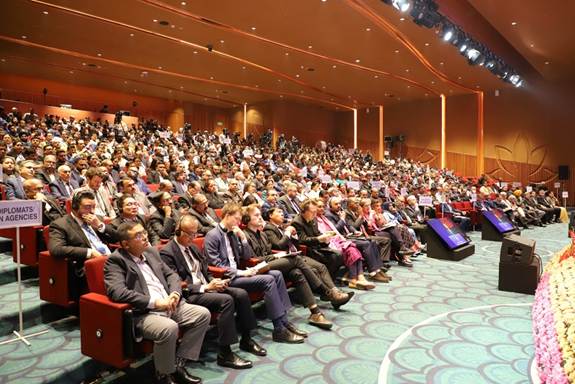
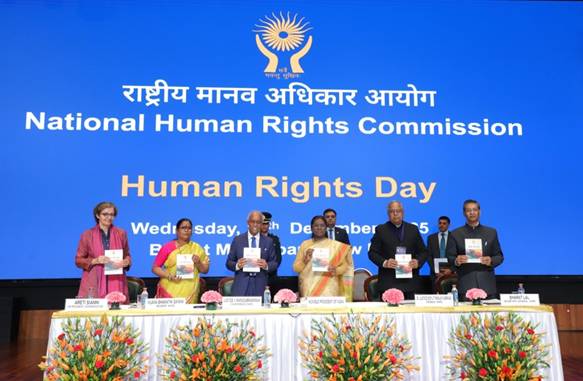
The National Human Rights Commission (NHRC), India organised a function today at Bharat Mandapam in New Delhi to celebrate Human Rights Day in commemoration of the Universal Declaration of Human Rights (UDHR) on this day in 1948 by the United Nations. The President of India, Smt Droupadi Murmu addressed as Chief Guest in the presence of NHRC, India Chairperson, Justice V. Ramasubramanian, Members, Justice (Dr) Bidyut Ranjan Sarangi, Smt Vijaya Bharathi Sayani, Secretary General, Shri Bharat Lal, UN Resident Coordinator In-charge, Ms Areti Sianni, Chairpersons and Members of State Human Rights Commissions, members of judiciary, senior government functionaries, diplomats, human rights defenders, representatives of NGO, civil society, academia among other national and international dignitaries were present.
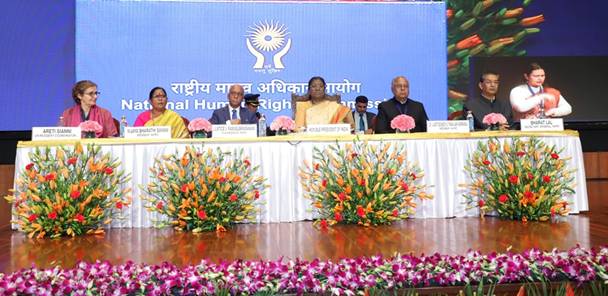
The President of India said the Human Rights Day is an occasion to remind us that the universal human rights are inalienable and they form the bedrock of a just, equitable and compassionate society. India played an important role in shaping a global framework of human rights. Our freedom fighters envisioned a world rooted in human dignity, equality and justice.
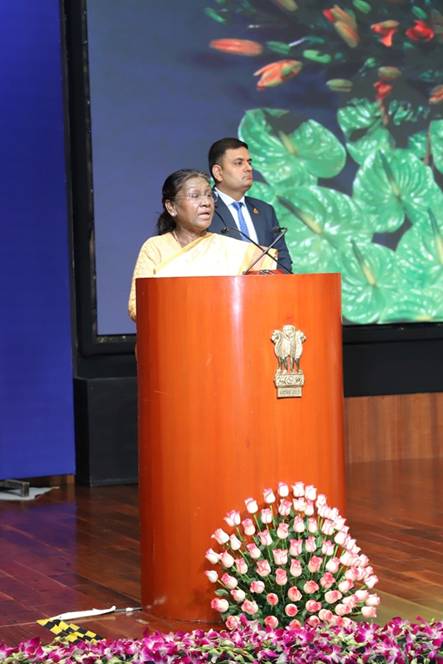
The President emphasised that human rights must be ensured for all, including the person in the last mile, in keeping with the philosophy of Antyodaya. She stated that each and every citizen should be an active participant in the nation’s development journey towards building a Viksit Bharat by 2047. As citizens we have to supplement the efforts of the government to ensure that the benefits of government policies reach the last mile. Only then can development be called inclusive in the real sense. We have reminded the world that human rights cannot be divorced from development. Also, India has always adhered to the timeless truth: ‘There is no peace without justice and there is no justice without peace.’
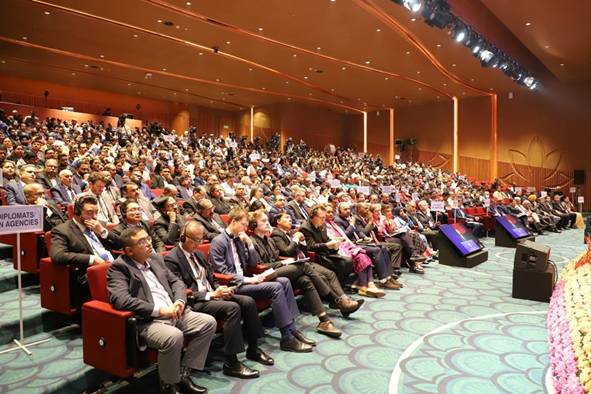
She said that the National Human Rights Commission, State Human Rights Commissions along with the judiciary and civil society have functioned as alert sentinels of our Constitutional conscience. She noted that over the past few years, the NHRC has taken suo motu cognizance of numerous issues concerning people from the Scheduled Caste and the Scheduled Tribe communities, as well as women and children. She also noted that the NHRC held extensive discussions on the subject of Human Rights of Prison Inmates during its Foundation Day celebrations this year. She expressed confidence that the discussions will yield useful results.
Smt. Murmu said that women’s empowerment and their welfare are key pillars of human rights. She was happy to note that NHRC has organised a conference on women’s safety in public places and workplaces. She stated that the conclusions drawn from such conferences can prove crucial in ensuring women’s safety and empowerment.
She said that the NHRC gives expression to certain ideals of the State and the society. The Government of India has been translating such expressions into action on a scale never seen before. Over the last decade, we have witnessed our Nation move ahead with a different approach from entitlement to empowerment and from charity to rights. The Government has been working to ensure that every day essential services like clean water, electricity, cooking gas, healthcare, banking services, education and improved sanitation become available to all. This uplifts every household and secures dignity.
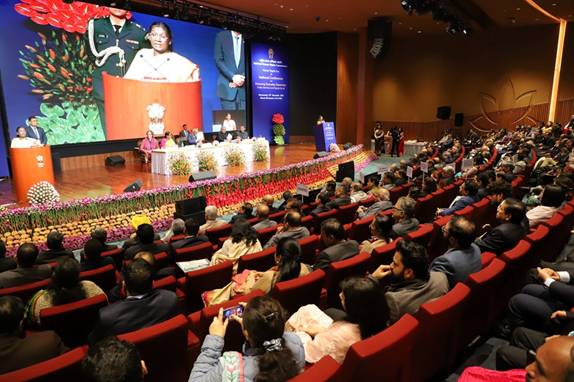
The President said that recently, the Government has notified the implementation of a major reform through the four Labour Codes related to wages, industrial relations, social security and occupational safety, health and working conditions. This transformative change lays the foundation for a future-ready workforce and more resilient industries.
Smt. Murmu called upon every citizen to recognise that human rights are not the sole responsibility of governments, the NHRC, civil society organisations and such other institutions. She said that protecting the rights and dignity of our fellow citizens is a shared duty. This duty rests with all of us as members of a compassionate and responsible society.
Earlier, NHRC, India Chairperson, Justice Shri V. Ramasubramanian said that it is intended to prompt us to have introspection and to encourage us to redeem our pledge to promote human rights as inalienable, indivisible and interdependent human values. It is only when human rights are elevated to the level of human values that this celebration will achieve its purpose. Quoting Eleanor Roosevelt speech at the UN commemorating the 10th Anniversary of the UDHR, he emphasised that human rights begin at such places where every man, woman and child seeks equal justice, equal opportunity, equal dignity without discrimination. Unless these rights have meaning there, they have little meaning anywhere. He called for using the Human Rights Day celebration as an opportunity to rededicate ourselves to the cause of protecting and promoting human rights.
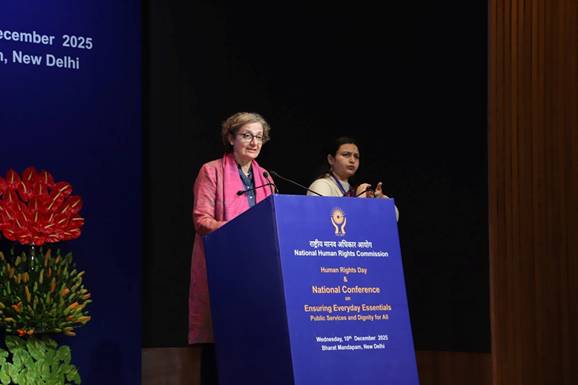
On the occasion, the United Nations Secretary-General, Mr António Guterres, in his message, read out by the UN Resident Coordinator In-charge, Ms Areti Sianni, said that our rights should never take second place to profit or power. Let us unite to protect them for the dignity and freedom of all.
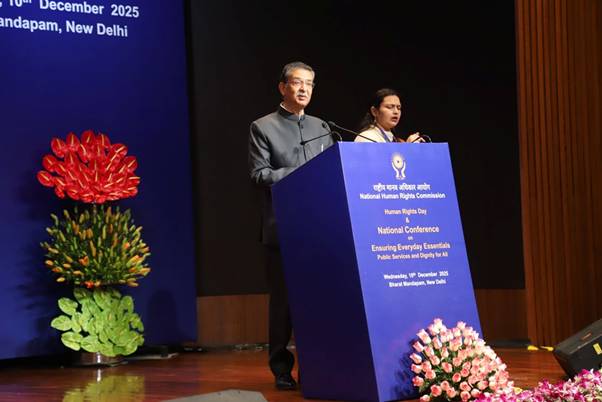
The NHRC, India Secretary General, Shri Bharat Lal, in his welcome address said that the Commission is a people’s institution. It always stands with the people, especially the most vulnerable, who need it most. Collectively, we need to create an environment and ensure that everyone realises their full potential by building a just, inclusive and equitable society where every person is treated with respect and lives with dignity in daily experiences at home, in public spaces and workplaces.
On the occasion, the President also launched the NHRC Mobile App, enabling easy complaint filing, real-time tracking and access to the Commission’s various IEC – Information, Education and Communication resources.
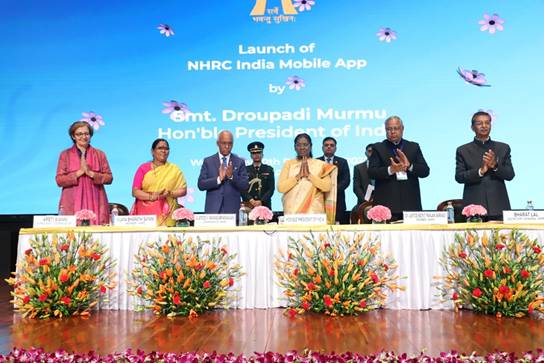
Besides, two NHRC publications were also released. These included Hindi and English Journals carrying articles by eminent experts to further deepen public understanding of human rights issues.
The Commission also organised a National Conference on ‘Ensuring Everyday Essentials: Public Services and Dignity for All’, to mark the significance of Human Rights Day.